
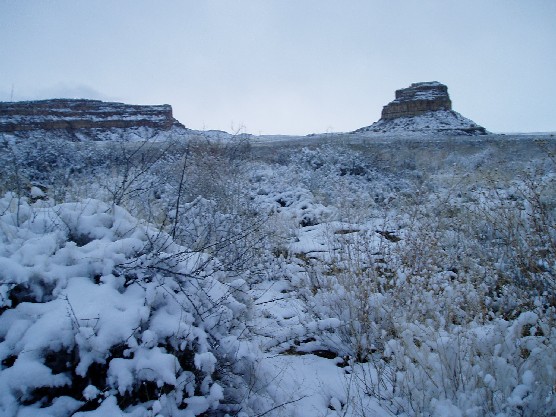
Chaco Culture National Historical Park — a dark sky place in San Juan County, New Mexico — is a popular subject for landscape photographers. The nearest town is Crownpoint, about 46 km (28 mi) away (Chaco Culture National Historical Park lies NNE of town). It is certified as an International Dark Sky Park by DarkSky International.
Chaco Culture National Historical Park is a United States National Historical Park in the American Southwest hosting a large concentration of pre-Columbian indigenous ruins of pueblos. The park is in northwestern New Mexico, between Albuquerque and Farmington, in a remote canyon cut by the Chaco Wash. Containing the most sweeping collection of ancient ruins north of Mexico, the park preserves one of the most important cultural and historical areas in the United States. Between 900 and 1150, Chaco Canyon was a major cultural center for the Ancestral Puebloans. Chacoans quarried sandstone blocks and hauled timber from great distances, assembling 15 major complexes that remained the largest buildings ever built in North America until the 19th century. Climate change is thought to have led to the migration of Chacoans and the eventual abandonment of the canyon, beginning with a 50-year...From the Wikipedia article “Chaco Culture National Historical Park”, licensed under CC BY-SA 4.0.
Sunrise & sunset directions
At Chaco Culture National Historical Park the sunrise point swings a long way through the year: about 60° (ENE) at the June solstice and 119° (ESE) in late December. Sunset moves from 300° (WNW) in June to 241° (WSW) in December, and the midday sun climbs to 77° in summer but only 31° in winter.
| Date | Sunrise | Azimuth | Sunset | Azimuth | Noon sun | Daylight |
|---|---|---|---|---|---|---|
| March equinox (Mar 20) | 7:16 AM | 90° E | 7:24 PM | 271° W | 54° | 12h 08m |
| June solstice (Jun 21) | 5:56 AM | 60° ENE | 8:33 PM | 300° WNW | 77° | 14h 37m |
| September equinox (Sep 22) | 7:01 AM | 89° E | 7:10 PM | 271° W | 54° | 12h 10m |
| December solstice (Dec 21) | 7:20 AM | 119° ESE | 5:02 PM | 241° WSW | 31° | 9h 42m |
Azimuth is measured clockwise from true north (90° = east, 270° = west). Computed for 2026; values change by less than a degree from year to year.
Golden hour & blue hour by month
Certified dark sky places offer protected night skies — plan around the new moon and the Milky Way core season.
| Month (15th) | Blue hour starts | Sunrise | Golden hour ends | Golden hour starts | Sunset | Blue hour ends | Daylight |
|---|---|---|---|---|---|---|---|
| January | 6:55 AM | 7:23 AM | 8:01 AM | 4:43 PM | 5:21 PM | 5:49 PM | 9h 59m |
| February | 6:34 AM | 7:00 AM | 7:36 AM | 5:18 PM | 5:54 PM | 6:20 PM | 10h 53m |
| March | 6:58 AM | 7:24 AM | 7:58 AM | 6:46 PM | 7:20 PM | 7:45 PM | 11h 56m |
| April | 6:13 AM | 6:39 AM | 7:14 AM | 7:11 PM | 7:46 PM | 8:12 PM | 13h 06m |
| May | 5:38 AM | 6:07 AM | 6:43 AM | 7:35 PM | 8:11 PM | 8:40 PM | 14h 05m |
| June | 5:25 AM | 5:55 AM | 6:33 AM | 7:53 PM | 8:31 PM | 9:01 PM | 14h 36m |
| July | 5:38 AM | 6:07 AM | 6:44 AM | 7:52 PM | 8:30 PM | 8:59 PM | 14h 23m |
| August | 6:04 AM | 6:31 AM | 7:06 AM | 7:28 PM | 8:03 PM | 8:31 PM | 13h 32m |
| September | 6:29 AM | 6:55 AM | 7:29 AM | 6:47 PM | 7:21 PM | 7:47 PM | 12h 26m |
| October | 6:53 AM | 7:19 AM | 7:54 AM | 6:03 PM | 6:37 PM | 7:03 PM | 11h 18m |
| November | 6:22 AM | 6:49 AM | 7:27 AM | 4:28 PM | 5:05 PM | 5:33 PM | 10h 16m |
| December | 6:48 AM | 7:16 AM | 7:56 AM | 4:20 PM | 5:00 PM | 5:28 PM | 9h 43m |
Local time (America/Denver), including daylight saving time. Golden hour runs from about −4° to +6° solar altitude, so the morning golden hour begins during blue hour, before sunrise.
Milky Way & night sky
From Chaco Culture National Historical Park, the Milky Way core is visible in a dark sky from February through October. June gives the longest window (about 5.7 hours on a moonless night), and the core peaks around 25° above the southern horizon. Our light-pollution model puts the sky at about Bortle 1 (excellent dark-sky site), which is excellent for astrophotography.
| Month | Core visible (15th) | Hours | Max altitude | Direction |
|---|---|---|---|---|
| January | Below 10° in darkness | — | 0° | — |
| February | 5:00 AM – 5:30 AM | 0.5 | 15° | SE → SE |
| March | 4:05 AM – 5:55 AM | 1.8 | 22° | SE → SSE |
| April | 2:06 AM – 5:06 AM | 3.0 | 25° | SE → S |
| May | 12:12 AM – 4:22 AM | 4.2 | 25° | SE → SSW |
| June | 10:21 PM – 4:01 AM | 5.7 | 25° | SE → SW |
| July | 10:15 PM – 2:35 AM | 4.3 | 25° | SSE → SW |
| August | 9:38 PM – 12:38 AM | 3.0 | 25° | S → SW |
| September | 8:48 PM – 10:28 PM | 1.7 | 22° | SSW → SW |
| October | 8:03 PM – 8:33 PM | 0.5 | 15° | SW → SW |
| November | Below 10° in darkness | — | 2° | — |
| December | Below 10° in darkness | — | -19° | — |
Window when the galactic core is at least 10° high during astronomical darkness on the 15th of each month. Pick nights within a few days of the new moon. Plan exact nights with the Milky Way planner.
Estimated sky darkness: 1 Bortle 1 — Excellent dark-sky site. The Milky Way casts faint shadows; zodiacal light and airglow are obvious. Modeled zenith brightness ≈ 21.89 mag/arcsec².
Weather & best season
Long-term NASA satellite data for this area show June as the clearest month (about 31% average cloud cover) and December as the cloudiest (55%). July is the warmest month and January the coldest, which matters for gear, snow access and how long batteries last at night.
Average cloud cover (%)
| Jan | Feb | Mar | Apr | May | Jun | Jul | Aug | Sep | Oct | Nov | Dec | |
|---|---|---|---|---|---|---|---|---|---|---|---|---|
| High °F | 60 | 65 | 78 | 83 | 96 | 99 | 101 | 97 | 94 | 83 | 72 | 60 |
| Low °F | -4 | -4 | 8 | 19 | 23 | 35 | 49 | 46 | 28 | 13 | 8 | -4 |
| Precip. (in) | 1.1 | 1.1 | 0.7 | 1.0 | 0.8 | 0.4 | 1.7 | 1.7 | 1.7 | 1.1 | 0.8 | 1.1 |
Monthly climatology for the surrounding 1° grid cell from NASA POWER (MERRA-2). Mountain sites can be colder and cloudier than the cell average.
Photography tips for this dark sky place
- Use red light only and keep it pointed down to protect others' night vision.
- Set focus on a bright star with live-view magnification, then tape the focus ring.
- Use the NPF rule below to choose the longest exposure before stars trail.
- Many parks host star parties and night programs during summer.
- Use the Milky Way table to find months and hours when the core is above the horizon.
- Tell someone where you're going in remote areas and carry the ten essentials.
Season: Milky Way core season runs roughly March to October; winter offers long nights and bright winter constellations.
Suggested gear: Fast wide lens (f/1.4–f/2.8), Sturdy tripod, Red headlamp, Intervalometer. Work out exposures with the depth of field, ND filter and NPF rule calculators.
Nearby photo spots
Other locations within 40 km of Chaco Culture National Historical Park, closest first.
 Mountain Pass
 Rock Formation
 Wilderness Area
 Wilderness Area
Campgrounds nearby (Recreation.gov)
FAQ
When is the best time to photograph Chaco Culture National Historical Park?
What time is golden hour at Chaco Culture National Historical Park?
Where does the sun rise and set at Chaco Culture National Historical Park?
Can you see the Milky Way from Chaco Culture National Historical Park?
Do you need a permit to photograph at Chaco Culture National Historical Park?
How far is Chaco Culture National Historical Park from Crownpoint?
Sources
Location data: DarkSky International (via Wikidata), Wikipedia. Sun, moon and Milky Way times are computed by LWPhoto Atlas for 2026. Climate: NASA POWER. Sky darkness is a population-based estimate (Walker's law), not a measurement. See data sources & licenses.