
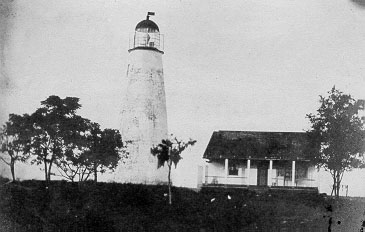
West Rigolets Light — a lighthouse in Orleans Parish, Louisiana — is a rewarding subject for landscape photographers. It sits roughly 7.9 km (4.9 mi) SE of Eden Isle. It dates from 1854.
The West Rigolets Light was a lighthouse which stood at the west end of the Rigolets where the channel meets Lake Pontchartrain. Built in 1855, it was deactivated sometime around World War II and was destroyed by Hurricane Katrina in 2005.From the Wikipedia article “West Rigolets Light”, licensed under CC BY-SA 4.0.
Sunrise & sunset directions
At West Rigolets Light the sunrise point swings a long way through the year: about 62° (ENE) at the June solstice and 117° (ESE) in late December. Sunset moves from 298° (WNW) in June to 243° (WSW) in December, and the midday sun climbs to 83° in summer but only 36° in winter.
| Date | Sunrise | Azimuth | Sunset | Azimuth | Noon sun | Daylight |
|---|---|---|---|---|---|---|
| March equinox (Mar 20) | 7:04 AM | 90° E | 7:11 PM | 271° W | 60° | 12h 07m |
| June solstice (Jun 21) | 5:59 AM | 62° ENE | 8:04 PM | 298° WNW | 83° | 14h 06m |
| September equinox (Sep 22) | 6:48 AM | 89° E | 6:57 PM | 271° W | 60° | 12h 09m |
| December solstice (Dec 21) | 6:52 AM | 117° ESE | 5:04 PM | 243° WSW | 36° | 10h 12m |
Azimuth is measured clockwise from true north (90° = east, 270° = west). Computed for 2026; values change by less than a degree from year to year.
Golden hour & blue hour by month
Lighthouses work at both ends of the day: blue hour when the beacon is lit, and golden hour when white towers take on warm tones.
| Month (15th) | Blue hour starts | Sunrise | Golden hour ends | Golden hour starts | Sunset | Blue hour ends | Daylight |
|---|---|---|---|---|---|---|---|
| January | 6:31 AM | 6:57 AM | 7:32 AM | 4:46 PM | 5:21 PM | 5:47 PM | 10h 25m |
| February | 6:16 AM | 6:40 AM | 7:13 AM | 5:15 PM | 5:48 PM | 6:13 PM | 11h 08m |
| March | 6:46 AM | 7:10 AM | 7:41 AM | 6:36 PM | 7:08 PM | 7:32 PM | 11h 58m |
| April | 6:08 AM | 6:33 AM | 7:05 AM | 6:54 PM | 7:27 PM | 7:51 PM | 12h 54m |
| May | 5:40 AM | 6:06 AM | 6:40 AM | 7:13 PM | 7:46 PM | 8:12 PM | 13h 40m |
| June | 5:30 AM | 5:58 AM | 6:33 AM | 7:28 PM | 8:03 PM | 8:30 PM | 14h 05m |
| July | 5:41 AM | 6:08 AM | 6:43 AM | 7:28 PM | 8:03 PM | 8:30 PM | 13h 55m |
| August | 6:02 AM | 6:27 AM | 7:00 AM | 7:09 PM | 7:42 PM | 8:07 PM | 13h 15m |
| September | 6:20 AM | 6:44 AM | 7:16 AM | 6:34 PM | 7:06 PM | 7:30 PM | 12h 22m |
| October | 6:37 AM | 7:02 AM | 7:34 AM | 5:57 PM | 6:29 PM | 6:53 PM | 11h 28m |
| November | 6:00 AM | 6:25 AM | 7:00 AM | 4:29 PM | 5:04 PM | 5:29 PM | 10h 38m |
| December | 6:22 AM | 6:49 AM | 7:25 AM | 4:25 PM | 5:01 PM | 5:28 PM | 10h 13m |
Local time (America/Chicago), including daylight saving time. Golden hour runs from about −4° to +6° solar altitude, so the morning golden hour begins during blue hour, before sunrise.
Milky Way & night sky
From West Rigolets Light, the Milky Way core is visible in a dark sky from February through October. June gives the longest window (about 6.7 hours on a moonless night), and the core peaks around 31° above the southern horizon. Our light-pollution model puts the sky at about Bortle 4 (rural / suburban transition), good enough for detailed Milky Way images.
| Month | Core visible (15th) | Hours | Max altitude | Direction |
|---|---|---|---|---|
| January | Below 10° in darkness | — | 1° | — |
| February | 4:19 AM – 5:19 AM | 1.0 | 19° | SE → SE |
| March | 3:27 AM – 5:47 AM | 2.3 | 28° | SE → SSE |
| April | 1:30 AM – 5:00 AM | 3.5 | 31° | SE → S |
| May | 11:27 PM – 4:27 AM | 5.0 | 31° | SE → SSW |
| June | 9:40 PM – 4:20 AM | 6.7 | 31° | SE → SW |
| July | 9:37 PM – 2:47 AM | 5.2 | 31° | SSE → SW |
| August | 9:08 PM – 12:48 AM | 3.7 | 31° | S → SW |
| September | 8:27 PM – 10:47 PM | 2.3 | 28° | SSW → SW |
| October | 7:49 PM – 8:49 PM | 1.0 | 19° | SW → SW |
| November | Below 10° in darkness | — | 4° | — |
| December | Below 10° in darkness | — | -18° | — |
Window when the galactic core is at least 10° high during astronomical darkness on the 15th of each month. Pick nights within a few days of the new moon. Plan exact nights with the Milky Way planner.
Estimated sky darkness: 4 Bortle 4 — Rural / suburban transition. Light domes are visible in several directions; the Milky Way is clear but lacks detail near the horizon. Modeled zenith brightness ≈ 20.78 mag/arcsec².
Weather & best season
Long-term NASA satellite data for this area show October as the clearest month (about 39% average cloud cover) and February as the cloudiest (60%). July is the warmest month and January the coldest, which matters for gear, snow access and how long batteries last at night.
Average cloud cover (%)
| Jan | Feb | Mar | Apr | May | Jun | Jul | Aug | Sep | Oct | Nov | Dec | |
|---|---|---|---|---|---|---|---|---|---|---|---|---|
| High °F | 76 | 80 | 85 | 90 | 98 | 106 | 103 | 106 | 99 | 94 | 83 | 80 |
| Low °F | 17 | 24 | 25 | 38 | 43 | 59 | 65 | 58 | 50 | 36 | 25 | 25 |
| Precip. (in) | 3.9 | 4.9 | 4.7 | 5.3 | 4.7 | 7.1 | 6.9 | 7.2 | 5.5 | 4.1 | 3.2 | 5.4 |
Monthly climatology for the surrounding 1° grid cell from NASA POWER (MERRA-2). Mountain sites can be colder and cloudier than the cell average.
Photography tips for this lighthouse
- Shoot from the beach or a jetty to place the tower against open sky and sea.
- Stormy weather and crashing surf add drama; keep a safe distance from waves on rocks and piers.
- A telephoto from across a bay compresses the tower against cliffs or the moon.
- Many lighthouses are on private or Coast Guard property — check public access and opening hours.
- Moonrise or the Milky Way over the tower makes a classic night composition; plan with the azimuth tables.
- Scout in daylight if you plan to shoot at night or before sunrise.
Season: Summer brings open towers and tours; autumn and winter offer storms, fewer crowds and lower sun angles.
Suggested gear: Tripod, Telephoto lens, ND filter for smooth water, Rain cover. Work out exposures with the depth of field, ND filter and NPF rule calculators.
Tides
The nearest NOAA tide prediction station is The Rigolets, U.S. Highway 90, 1.2 km (0.7 mi) away. Low tide often reveals tide pools, wet-sand reflections and sea stacks.
Nearby photo spots
Other locations within 25 km of West Rigolets Light, closest first.
 Beach
 Lake
 Lighthouse
 National Wildlife Refuge
 Lighthouse
 National Wildlife Refuge
FAQ
When is the best time to photograph West Rigolets Light?
What time is golden hour at West Rigolets Light?
Where does the sun rise and set at West Rigolets Light?
Can you see the Milky Way from West Rigolets Light?
Do you need a permit to photograph at West Rigolets Light?
How far is West Rigolets Light from Eden Isle?
Sources
Location data: Wikidata, Wikipedia. Sun, moon and Milky Way times are computed by LWPhoto Atlas for 2026. Climate: NASA POWER. Sky darkness is a population-based estimate (Walker's law), not a measurement. See data sources & licenses.