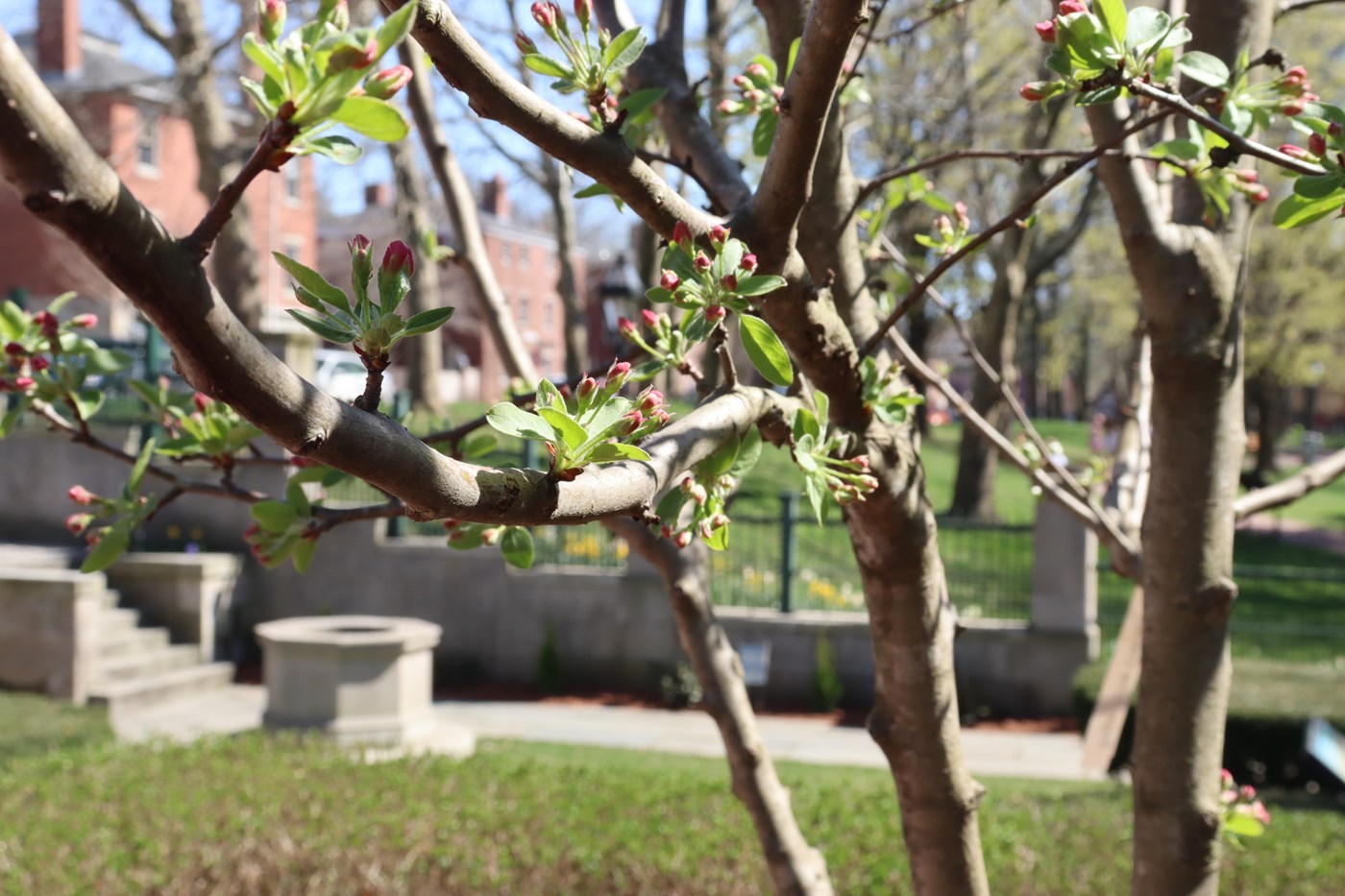
Roger Williams National Memorial is a National Memorial in Rhode Island. This guide combines the park's official information with computed sunrise, sunset and Milky Way times, satellite climate data and nearby photo locations.
Sunrise, sunset & golden hour
At Roger Williams the sunrise point swings a long way through the year: about 57° (ENE) at the June solstice and 122° (ESE) in late December. Sunset moves from 303° (WNW) in June to 239° (WSW) in December, and the midday sun climbs to 72° in summer but only 25° in winter.
| Month (15th) | Sunrise | Golden hour ends | Golden hour starts | Sunset | Sunset az. | Daylight |
|---|---|---|---|---|---|---|
| January | 7:11 AM | 7:55 AM | 3:57 PM | 4:40 PM | 242° | 9h 28m |
| February | 6:42 AM | 7:21 AM | 4:40 PM | 5:19 PM | 254° | 10h 37m |
| March | 6:59 AM | 7:35 AM | 6:15 PM | 6:52 PM | 268° | 11h 54m |
| April | 6:06 AM | 6:44 AM | 6:49 PM | 7:26 PM | 284° | 13h 20m |
| May | 5:27 AM | 6:07 AM | 7:19 PM | 7:59 PM | 297° | 14h 33m |
| June | 5:11 AM | 5:53 AM | 7:41 PM | 8:23 PM | 303° | 15h 12m |
| July | 5:24 AM | 6:06 AM | 7:39 PM | 8:20 PM | 300° | 14h 56m |
| August | 5:55 AM | 6:33 AM | 7:09 PM | 7:48 PM | 290° | 13h 53m |
| September | 6:27 AM | 7:03 AM | 6:20 PM | 6:57 PM | 275° | 12h 31m |
| October | 6:58 AM | 7:36 AM | 5:28 PM | 6:06 PM | 259° | 11h 07m |
| November | 6:36 AM | 7:17 AM | 3:45 PM | 4:26 PM | 246° | 9h 51m |
| December | 7:07 AM | 7:52 AM | 3:32 PM | 4:16 PM | 239° | 9h 09m |
Computed for the park's reference point (41.8299, -71.4106); large parks span several minutes of difference.
Milky Way & dark skies
From Roger Williams, the Milky Way core is visible in a dark sky from March through September. June gives the longest window (about 4.3 hours on a moonless night), and the core peaks around 19° above the southern horizon. Our light-pollution model puts the sky at about Bortle 8 (city sky), so expect visible sky glow; drive away from towns for better results.
| Month | Core visible (15th) | Hours | Max altitude |
|---|---|---|---|
| January | Not visible in darkness | — | — |
| February | Not visible in darkness | — | — |
| March | 4:16 AM – 5:16 AM | 1.0 | 16° |
| April | 2:17 AM – 4:17 AM | 2.0 | 19° |
| May | 12:25 AM – 3:25 AM | 3.0 | 19° |
| June | 10:34 PM – 2:54 AM | 4.3 | 19° |
| July | 10:24 PM – 1:34 AM | 3.2 | 19° |
| August | 9:34 PM – 11:34 PM | 2.0 | 19° |
| September | 8:32 PM – 9:32 PM | 1.0 | 16° |
| October | Not visible in darkness | — | — |
| November | Not visible in darkness | — | — |
| December | Not visible in darkness | — | — |
8 Estimated Bortle 8 — City sky. Only bright constellations are visible; the sky glows orange or white.
Weather & best time to visit
At Roger Williams National Memorial in Providence, the weather varies with the seasons. Spring and fall are mild, with temperatures in the 50s to 60s Fahrenheit and occasional rain. Summers are warm and humid, reaching the 70s to 80s, while winters are cold, often in the 30s and 40s, with chances of snow. Check the forecast before visiting and dress in layers for comfort.
Weather overview: National Park Service.
Long-term NASA satellite data for this area show August as the clearest month (about 52% average cloud cover) and January as the cloudiest (69%). August is the warmest month and January the coldest, which matters for gear, snow access and how long batteries last at night.
Average cloud cover (%)
Average high (°F)
Photography permits, drones & fees
Permits. Under federal law (54 U.S.C. 100905), still photography in National Park Service areas needs a permit only when it (1) takes place where members of the public are not allowed, (2) uses models, sets or props that are not part of the location's natural or cultural resources or administrative facilities, or (3) would cause the park to incur additional administrative costs to monitor the activity. Ordinary visitor and most landscape photography needs no permit. Commercial filming rules are separate and have changed in recent years — confirm current requirements with the park before a paid shoot.
Drones. Launching, landing or operating unmanned aircraft (drones) is prohibited in National Park Service units under a 2014 Superintendent's closure (36 CFR 1.5), except where a park has issued specific written approval. Flying from outside the boundary over park land can also violate park rules and disturb wildlife.
Getting there
From Interstate 95 North, take Exit 38 - State Offices. Stay to the right. At end of exit, go straight. At next light, make a left onto Smith St. At light, make a right and then a quick left into the memorial's parking lot. From Interstate 95 South, take Exit 38 - Charles Street. Make a right onto Charles St. and take first left onto Ashburton Street. Continue straight through three lights. After the third light, take a quick left into the memorial parking lot.
Directions: National Park Service.
Activities
- Arts and Culture
- Cultural Demonstrations
- Live Music
- Food
- Guided Tours
- Self-Guided Tours - Walking
- Living History
- First Person Interpretation
- Junior Ranger Program
- Shopping
- Bookstore and Park Store
- Gift Shop and Souvenirs
Nearby parks
 RI/MA
 RI
 MA
 MA
 MA
 MA