
From central Idaho the Milky Way's galactic core is visible in true darkness from March to September, with the longest viewing window in June. Below: monthly times, the next new moons, and the darkest photo locations in Idaho ranked by our light-pollution model.
Milky Way core visibility in Idaho by month
| Month | Core visible (15th) | Hours | Max altitude | Direction |
|---|---|---|---|---|
| January | — | — | -5° | — |
| February | — | — | 8° | — |
| March | 5:33 AM – 6:13 AM | 0.7 | 14° | SSE → SSE |
| April | 3:29 AM – 5:09 AM | 1.7 | 16° | SSE → S |
| May | 1:35 AM – 4:05 AM | 2.5 | 17° | SSE → S |
| June | 11:51 PM – 3:31 AM | 3.7 | 17° | SSE → SSW |
| July | 11:37 PM – 2:07 AM | 2.5 | 17° | S → SSW |
| August | 10:38 PM – 12:08 AM | 1.5 | 16° | S → SSW |
| September | 9:31 PM – 10:01 PM | 0.5 | 13° | SSW → SSW |
| October | — | — | 8° | — |
| November | — | — | -2° | — |
| December | — | — | -20° | — |
Computed for central Idaho (44.1, -114.95) — core at least 10° high during astronomical darkness. Northern parts of the state see it lower and for less time.
Next new moons (darkest nights)
| Date | Time | Milky Way |
|---|---|---|
| Mon, Nov 09, 2026 | 12:02 AM | Core below horizon at night |
| Tue, Dec 08, 2026 | 5:52 PM | Core below horizon at night |
| Thu, Jan 07, 2027 | 1:24 PM | Core below horizon at night |
| Sat, Feb 06, 2027 | 8:56 AM | Core below horizon at night |
| Mon, Mar 08, 2027 | 2:29 AM | Core season |
| Tue, Apr 06, 2027 | 5:51 PM | Core season |
| Thu, May 06, 2027 | 4:58 AM | Core season |
| Fri, Jun 04, 2027 | 1:40 PM | Core season |
| Sat, Jul 03, 2027 | 9:02 PM | Core season |
| Mon, Aug 02, 2027 | 4:05 AM | Core season |
| Tue, Aug 31, 2027 | 11:41 AM | Core season |
| Wed, Sep 29, 2027 | 8:36 PM | Core season |
| Fri, Oct 29, 2027 | 7:36 AM | Core below horizon at night |
New moon times from the U.S. Naval Observatory, converted to local time. The 3–4 nights either side are also dark in the evening or morning.
Darkest photo locations in Idaho
| Location | Type | County | Est. Bortle | Zenith mag/arcsec² |
|---|---|---|---|---|
| Craters of the Moon National Monument and Preserve | Dark Sky Place | Butte County | 1 | 21.91 |
| Central Idaho Dark Sky Reserve | Dark Sky Place | Custer County | 1 | 21.91 |
| City of Rocks National Reserve | State Park | Cassia County | 2 | 21.88 |
| Castle Rocks State Park | State Park | Cassia County | 2 | 21.88 |
| Land of the Yankee Fork State Park | State Park | Custer County | 1 | 21.93 |
| Three Island Crossing State Park | State Park | Elmore County | 2 | 21.87 |
| Lake Cascade State Park | State Park | Valley County | 2 | 21.88 |
| Castle Rocks Geological Area Overlook | Scenic Viewpoint | Cassia County | 2 | 21.88 |
| Cabinet Dam Viewpoint | Scenic Viewpoint | Bonner County | 2 | 21.87 |
| Carey Dome Scenic View | Scenic Viewpoint | Idaho County | 1 | 21.93 |
| Galena Overlook | Scenic Viewpoint | Blaine County | 1 | 21.90 |
| Grandview Overlook | Scenic Viewpoint | Fremont County | 1 | 21.91 |
| Hughes Ridge Viewpoint | Scenic Viewpoint | Boundary County | 1 | 21.92 |
| Lloyds Lake Overlook | Scenic Viewpoint | Idaho County | 1 | 21.92 |
| Lookout Point | Scenic Viewpoint | Owyhee County | 1 | 21.92 |
| Overlook Mill | Scenic Viewpoint | Elmore County | 2 | 21.87 |
| Park Creek Overlook | Scenic Viewpoint | Custer County | 1 | 21.91 |
| Sabe Vista Point | Scenic Viewpoint | Idaho County | 1 | 21.94 |
| Sheep Rock Overlook | Scenic Viewpoint | Adams County | 1 | 21.91 |
| Thatcher Creek Overlook | Scenic Viewpoint | Custer County | 1 | 21.91 |
Sky brightness is modeled from nearby town populations (Walker's law); terrain, altitude and local lighting can make real skies better or worse.
Certified dark sky places in Idaho
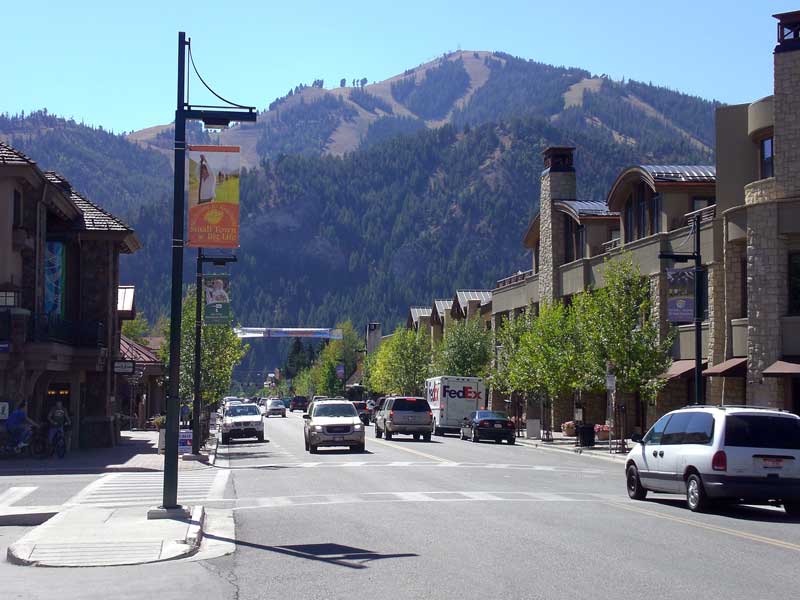 Dark Sky Place
 Dark Sky Place
 Dark Sky Place
Starting exposure for sharp stars (NPF rule)
| Sensor | Lens | Aperture | NPF max shutter | 500 rule |
|---|---|---|---|---|
| Full frame (35 mm) | 14 mm | f/2.8 | 19.6 s | 36 s |
| Full frame (35 mm) | 20 mm | f/2.8 | 13.8 s | 25 s |
| Full frame (35 mm) | 24 mm | f/2.8 | 11.5 s | 21 s |
| APS-C (Nikon, Sony, Fujifilm, Pentax) | 14 mm | f/2.8 | 15.4 s | 23 s |
| APS-C (Nikon, Sony, Fujifilm, Pentax) | 20 mm | f/2.8 | 10.8 s | 16 s |
| APS-C (Nikon, Sony, Fujifilm, Pentax) | 24 mm | f/2.8 | 9.0 s | 14 s |
| Micro Four Thirds | 14 mm | f/2.8 | 14.1 s | 18 s |
| Micro Four Thirds | 20 mm | f/2.8 | 9.8 s | 12 s |
| Micro Four Thirds | 24 mm | f/2.8 | 8.2 s | 10 s |
NPF = (35 × f-number + 30 × pixel pitch) ÷ focal length, using typical pixel pitch per format (24 MP FF, 24–26 MP APS-C, 20 MP MFT). Fine-tune for your camera with the NPF calculator.
Tips for Milky Way photography
- Shoot within a few days of the new moon, or after moonset / before moonrise.
- Use ISO 3200–6400 on modern full-frame sensors, f/1.8–f/2.8, and the NPF shutter time.
- Focus manually on a bright star with live view magnified, then lock the focus ring.
- Shoot a blue-hour or low-ISO foreground frame from the same tripod position and blend it later.
- Stack 10–20 frames to reduce noise, or use a star tracker for longer exposures.
- Check the darkest-location table above, then confirm the view to the south on the location's sun-path diagram.