
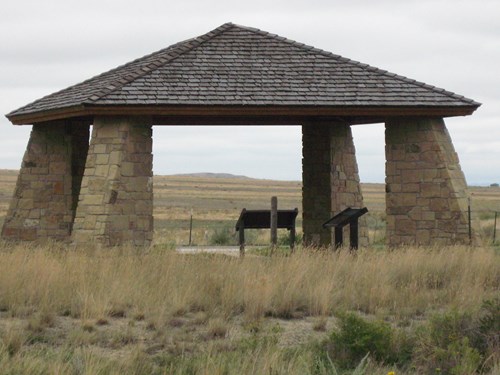
Hailstone National Wildlife Refuge is a national wildlife refuge in Stillwater County, Montana. It sits roughly 42 km (26 mi) N of Columbus.
Hailstone National Wildlife Refuge is a National Wildlife Refuge of the United States located in central Montana. Hailstone National Wildlife Refuge is one of several satellite refuges in the region that are part of the Charles M. Russell National Wildlife Refuge Complex. Satellite refuges are established by executive order and are unstaffed. Hailstone was initially established as an easement refuge in 1942 to provide a rest stop and breeding ground for migratory waterfowl. The United States Fish and Wildlife Service purchased the land in 1980. The refuge is located next to Hailstone Lake, a natural basin that was enhanced to 300 acres in the 1930s under the Works Project Administration. An earthen dam was erected on this natural wetland that increased its size and turned it into a reservoir. Over the years heavy metals and salts accumulated in the reservoir and surrounding soil due...From the Wikipedia article “Hailstone National Wildlife Refuge”, licensed under CC BY-SA 4.0.
Sunrise & sunset directions
At Hailstone National Wildlife Refuge the sunrise point swings a long way through the year: about 54° (NE) at the June solstice and 124° (SE) in late December. Sunset moves from 306° (NW) in June to 236° (WSW) in December, and the midday sun climbs to 67° in summer but only 21° in winter.
| Date | Sunrise | Azimuth | Sunset | Azimuth | Noon sun | Daylight |
|---|---|---|---|---|---|---|
| March equinox (Mar 20) | 7:21 AM | 89° E | 7:29 PM | 271° W | 44° | 12h 09m |
| June solstice (Jun 21) | 5:27 AM | 54° NE | 9:12 PM | 306° NW | 67° | 15h 45m |
| September equinox (Sep 22) | 7:04 AM | 89° E | 7:16 PM | 271° W | 44° | 12h 12m |
| December solstice (Dec 21) | 7:57 AM | 124° SE | 4:35 PM | 236° WSW | 21° | 8h 38m |
Azimuth is measured clockwise from true north (90° = east, 270° = west). Computed for 2026; values change by less than a degree from year to year.
Golden hour & blue hour by month
Wildlife is most active in the first and last two hours of daylight — exactly when the light is warmest.
| Month (15th) | Blue hour starts | Sunrise | Golden hour ends | Golden hour starts | Sunset | Blue hour ends | Daylight |
|---|---|---|---|---|---|---|---|
| January | 7:22 AM | 7:55 AM | 8:43 AM | 4:10 PM | 4:58 PM | 5:32 PM | 9h 03m |
| February | 6:50 AM | 7:20 AM | 8:03 AM | 5:01 PM | 5:43 PM | 6:14 PM | 10h 23m |
| March | 7:01 AM | 7:30 AM | 8:10 AM | 6:43 PM | 7:23 PM | 7:52 PM | 11h 52m |
| April | 6:00 AM | 6:31 AM | 7:11 AM | 7:23 PM | 8:04 PM | 8:35 PM | 13h 33m |
| May | 5:10 AM | 5:45 AM | 6:29 AM | 7:59 PM | 8:43 PM | 9:18 PM | 14h 57m |
| June | 4:48 AM | 5:26 AM | 6:12 AM | 8:24 PM | 9:10 PM | 9:49 PM | 15h 44m |
| July | 5:04 AM | 5:41 AM | 6:26 AM | 8:20 PM | 9:05 PM | 9:42 PM | 15h 24m |
| August | 5:44 AM | 6:17 AM | 6:58 AM | 7:46 PM | 8:27 PM | 9:00 PM | 14h 10m |
| September | 6:26 AM | 6:56 AM | 7:35 AM | 6:51 PM | 7:30 PM | 8:00 PM | 12h 34m |
| October | 7:04 AM | 7:34 AM | 8:15 AM | 5:51 PM | 6:32 PM | 7:02 PM | 10h 58m |
| November | 6:46 AM | 7:18 AM | 8:04 AM | 4:01 PM | 4:46 PM | 5:19 PM | 9h 28m |
| December | 7:18 AM | 7:53 AM | 8:43 AM | 3:43 PM | 4:33 PM | 5:07 PM | 8h 40m |
Local time (America/Denver), including daylight saving time. Golden hour runs from about −4° to +6° solar altitude, so the morning golden hour begins during blue hour, before sunrise.
Milky Way & night sky
From Hailstone National Wildlife Refuge, the Milky Way core is visible in a dark sky from April through August. June gives the longest window (about 2.8 hours on a moonless night), and the core peaks around 15° above the southern horizon. Our light-pollution model puts the sky at about Bortle 2 (typical truly dark site), which is excellent for astrophotography.
| Month | Core visible (15th) | Hours | Max altitude | Direction |
|---|---|---|---|---|
| January | Below 10° in darkness | — | -5° | — |
| February | Below 10° in darkness | — | 6° | — |
| March | 5:33 AM – 5:43 AM | 0.2 | 11° | SSE → SSE |
| April | 3:24 AM – 4:34 AM | 1.2 | 14° | SSE → SSE |
| May | 1:27 AM – 3:27 AM | 2.0 | 15° | SSE → S |
| June | 11:53 PM – 2:43 AM | 2.8 | 15° | SSE → SSW |
| July | 11:33 PM – 1:23 AM | 1.8 | 15° | S → SSW |
| August | 10:26 PM – 11:26 PM | 1.0 | 14° | SSW → SSW |
| September | 9:13 PM – 9:23 PM | 0.2 | 11° | SSW → SSW |
| October | Below 10° in darkness | — | 6° | — |
| November | Below 10° in darkness | — | -3° | — |
| December | Below 10° in darkness | — | -20° | — |
Window when the galactic core is at least 10° high during astronomical darkness on the 15th of each month. Pick nights within a few days of the new moon. Plan exact nights with the Milky Way planner.
Estimated sky darkness: 2 Bortle 2 — Typical truly dark site. The summer Milky Way shows rich structure; clouds look like black holes in the stars. Modeled zenith brightness ≈ 21.89 mag/arcsec². Aurora needs roughly Kp 4.5+ to show low on the northern horizon here.
Weather & best season
Long-term NASA satellite data for this area show July as the clearest month (about 41% average cloud cover) and March as the cloudiest (71%). July is the warmest month and December the coldest, which matters for gear, snow access and how long batteries last at night.
Average cloud cover (%)
| Jan | Feb | Mar | Apr | May | Jun | Jul | Aug | Sep | Oct | Nov | Dec | |
|---|---|---|---|---|---|---|---|---|---|---|---|---|
| High °F | 57 | 59 | 74 | 82 | 88 | 97 | 105 | 100 | 93 | 87 | 69 | 54 |
| Low °F | -32 | -25 | -32 | 6 | 21 | 30 | 40 | 37 | 19 | -3 | -16 | -23 |
| Precip. (in) | 0.8 | 1.0 | 1.1 | 2.2 | 3.2 | 3.2 | 1.6 | 1.7 | 1.7 | 1.6 | 1.0 | 0.8 |
Monthly climatology for the surrounding 1° grid cell from NASA POWER (MERRA-2). Mountain sites can be colder and cloudier than the cell average.
Photography tips for this national wildlife refuge
- Migration peaks bring the largest concentrations — see the birding calendar for this state.
- Use auto-loop roads as mobile blinds; animals often tolerate vehicles more than people on foot.
- Stay on designated routes and keep a respectful distance — if an animal changes behavior, you are too close.
- A 400–600 mm lens (or a crop body) is the usual tool for birds.
- Fast shutter speeds (1/2000 s+) freeze wingbeats; raise ISO rather than lose the shot.
- Shoot RAW to keep the most latitude for high-contrast sunrise and sunset scenes.
Season: Spring and autumn migration are the highlights; winter brings waterfowl to many southern refuges.
Suggested gear: Telephoto lens (400 mm+), Bean bag for car window, Binoculars. Work out exposures with the depth of field, ND filter and NPF rule calculators.
Permits, drones & access
Drones: Launching or landing drones on National Wildlife Refuge lands generally requires a special use permit from the refuge manager, and wildlife disturbance rules apply everywhere.
Nearby photo spots
Other locations within 40 km of Hailstone National Wildlife Refuge, closest first.

FAQ
When is the best time to photograph Hailstone National Wildlife Refuge?
What time is golden hour at Hailstone National Wildlife Refuge?
Where does the sun rise and set at Hailstone National Wildlife Refuge?
Can you see the Milky Way from Hailstone National Wildlife Refuge?
Do you need a permit to photograph at Hailstone National Wildlife Refuge?
How far is Hailstone National Wildlife Refuge from Columbus?
Sources
Location data: Wikidata, Wikipedia. Sun, moon and Milky Way times are computed by LWPhoto Atlas for 2026. Climate: NASA POWER. Sky darkness is a population-based estimate (Walker's law), not a measurement. See data sources & licenses.