
Black's Beach is a beach in San Diego County, California. The nearest town is La Jolla, about 5.4 km (3.4 mi) away (Black's Beach lies NNE of town).
Black's Beach is a secluded section of beach beneath the bluffs of Torrey Pines on the Pacific Ocean in La Jolla, a community of San Diego, California. It is officially part of Torrey Pines State Beach. The northern portion of Black's Beach is owned and managed by the California Department of Parks and Recreation, while the southern portion of the beach, officially known as Torrey Pines City Beach, is jointly owned by the City of San Diego and the state park, and managed by the City of San Diego. This distinction is important as Black's Beach is most known as a nude beach. Black's Beach was named for the Black family who had a horse ranch overlooking the beach. They sold the land, and then it was subdivided into La Jolla Farms lots. The Farms' residents retained the Black family's private road to the beach. Many mansions can be seen in the southern portion of the beach, including the...From the Wikipedia article “Black's Beach”, licensed under CC BY-SA 4.0.
Sunrise & sunset directions
At Black's Beach the sunrise point swings a long way through the year: about 61° (ENE) at the June solstice and 118° (ESE) in late December. Sunset moves from 299° (WNW) in June to 242° (WSW) in December, and the midday sun climbs to 81° in summer but only 34° in winter.
| Date | Sunrise | Azimuth | Sunset | Azimuth | Noon sun | Daylight |
|---|---|---|---|---|---|---|
| March equinox (Mar 20) | 6:54 AM | 90° E | 7:01 PM | 271° W | 57° | 12h 07m |
| June solstice (Jun 21) | 5:42 AM | 61° ENE | 8:01 PM | 299° WNW | 81° | 14h 19m |
| September equinox (Sep 22) | 6:38 AM | 89° E | 6:47 PM | 271° W | 57° | 12h 09m |
| December solstice (Dec 21) | 6:49 AM | 118° ESE | 4:47 PM | 242° WSW | 34° | 9h 59m |
Azimuth is measured clockwise from true north (90° = east, 270° = west). Computed for 2026; values change by less than a degree from year to year.
Golden hour & blue hour by month
Beaches facing east suit sunrise and west-facing beaches suit sunset; wet sand mirrors the sky color during golden hour.
| Month (15th) | Blue hour starts | Sunrise | Golden hour ends | Golden hour starts | Sunset | Blue hour ends | Daylight |
|---|---|---|---|---|---|---|---|
| January | 6:26 AM | 6:52 AM | 7:29 AM | 4:29 PM | 5:06 PM | 5:32 PM | 10h 13m |
| February | 6:08 AM | 6:33 AM | 7:07 AM | 5:01 PM | 5:35 PM | 6:00 PM | 11h 02m |
| March | 6:36 AM | 7:00 AM | 7:33 AM | 6:25 PM | 6:57 PM | 7:22 PM | 11h 57m |
| April | 5:54 AM | 6:20 AM | 6:53 AM | 6:46 PM | 7:19 PM | 7:45 PM | 13h 00m |
| May | 5:24 AM | 5:51 AM | 6:26 AM | 7:07 PM | 7:42 PM | 8:09 PM | 13h 51m |
| June | 5:12 AM | 5:41 AM | 6:17 AM | 7:23 PM | 8:00 PM | 8:28 PM | 14h 18m |
| July | 5:24 AM | 5:52 AM | 6:28 AM | 7:23 PM | 7:59 PM | 8:27 PM | 14h 07m |
| August | 5:47 AM | 6:13 AM | 6:47 AM | 7:02 PM | 7:36 PM | 8:02 PM | 13h 23m |
| September | 6:09 AM | 6:33 AM | 7:06 AM | 6:24 PM | 6:57 PM | 7:22 PM | 12h 23m |
| October | 6:29 AM | 6:54 AM | 7:27 AM | 5:44 PM | 6:17 PM | 6:42 PM | 11h 23m |
| November | 5:54 AM | 6:20 AM | 6:56 AM | 4:13 PM | 4:49 PM | 5:15 PM | 10h 28m |
| December | 6:18 AM | 6:45 AM | 7:23 AM | 4:07 PM | 4:45 PM | 5:12 PM | 10h 00m |
Local time (America/Los Angeles), including daylight saving time. Golden hour runs from about −4° to +6° solar altitude, so the morning golden hour begins during blue hour, before sunrise.
Milky Way & night sky
From Black's Beach, the Milky Way core is visible in a dark sky from February through October. June gives the longest window (about 6.2 hours on a moonless night), and the core peaks around 28° above the southern horizon. Our light-pollution model puts the sky at about Bortle 6 (bright suburban sky), so expect visible sky glow; drive away from towns for better results.
| Month | Core visible (15th) | Hours | Max altitude | Direction |
|---|---|---|---|---|
| January | Below 10° in darkness | — | 1° | — |
| February | 4:18 AM – 5:08 AM | 0.8 | 17° | SE → SE |
| March | 3:30 AM – 5:30 AM | 2.0 | 24° | SE → SSE |
| April | 1:26 AM – 4:46 AM | 3.3 | 28° | SE → S |
| May | 11:27 PM – 4:07 AM | 4.7 | 28° | SE → SSW |
| June | 9:42 PM – 3:52 AM | 6.2 | 28° | SE → SW |
| July | 9:38 PM – 2:28 AM | 4.8 | 28° | SSE → SW |
| August | 9:06 PM – 12:26 AM | 3.3 | 28° | S → SW |
| September | 8:20 PM – 10:20 PM | 2.0 | 25° | SSW → SW |
| October | 7:39 PM – 8:29 PM | 0.8 | 17° | SW → SW |
| November | Below 10° in darkness | — | 3° | — |
| December | Below 10° in darkness | — | -18° | — |
Window when the galactic core is at least 10° high during astronomical darkness on the 15th of each month. Pick nights within a few days of the new moon. Plan exact nights with the Milky Way planner.
Estimated sky darkness: 6 Bortle 6 — Bright suburban sky. The Milky Way is only visible near the zenith; the sky glows grey-orange in photos. Modeled zenith brightness ≈ 18.99 mag/arcsec².
Weather & best season
Long-term NASA satellite data for this area show January as the clearest month (about 50% average cloud cover) and June as the cloudiest (81%). September is the warmest month and February the coldest, which matters for gear, snow access and how long batteries last at night.
Average cloud cover (%)
| Jan | Feb | Mar | Apr | May | Jun | Jul | Aug | Sep | Oct | Nov | Dec | |
|---|---|---|---|---|---|---|---|---|---|---|---|---|
| High °F | 74 | 77 | 81 | 78 | 81 | 78 | 83 | 83 | 86 | 89 | 82 | 73 |
| Low °F | 48 | 48 | 51 | 50 | 52 | 54 | 57 | 59 | 58 | 57 | 51 | 51 |
| Precip. (in) | 1.6 | 2.2 | 1.1 | 0.7 | 0.2 | 1.1 | 0.1 | 0.1 | 0.1 | 0.6 | 1.0 | 1.9 |
Monthly climatology for the surrounding 1° grid cell from NASA POWER (MERRA-2). Mountain sites can be colder and cloudier than the cell average.
Photography tips for this beach
- Time visits around low tide to reveal tide pools, sea stacks and reflective sand — check the tide widget below.
- Slow shutter speeds (0.5–2 s) turn receding waves into streaks that lead toward the horizon.
- Watch for sneaker waves; never turn your back on the ocean on exposed coasts.
- Salt spray coats lenses quickly; wipe often and rinse gear afterward.
- Fog and marine layers can make minimalist images; don't give up on grey days.
- Scout in daylight if you plan to shoot at night or before sunrise.
Season: Winter storms bring dramatic surf on Pacific coasts; summer and autumn sunsets are popular on Atlantic and Gulf beaches.
Suggested gear: Tripod, ND filters, Rain cover, Lens cloths. Work out exposures with the depth of field, ND filter and NPF rule calculators.
Tides
The nearest NOAA tide prediction station is La Jolla (Scripps Institution Wharf), 2.9 km (1.8 mi) away. Low tide often reveals tide pools, wet-sand reflections and sea stacks.
Nearby photo spots
Other locations within 25 km of Black's Beach, closest first.
 State Park
 Canyon
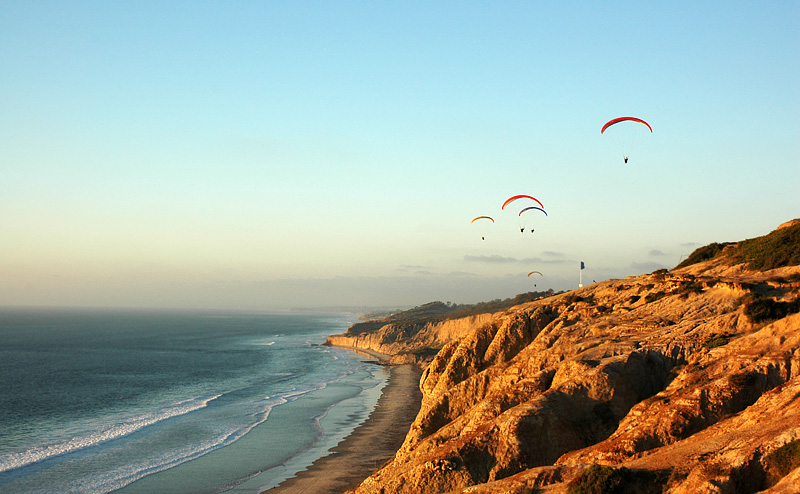 State Park
 Natural Arch
 Beach
 Beach
 Mountain Peak
 Beach
 Canyon
FAQ
When is the best time to photograph Black's Beach?
What time is golden hour at Black's Beach?
Where does the sun rise and set at Black's Beach?
Can you see the Milky Way from Black's Beach?
Do you need a permit to photograph at Black's Beach?
How far is Black's Beach from La Jolla?
Sources
Location data: Wikidata, Wikipedia. Sun, moon and Milky Way times are computed by LWPhoto Atlas for 2026. Climate: NASA POWER. Sky darkness is a population-based estimate (Walker's law), not a measurement. See data sources & licenses.