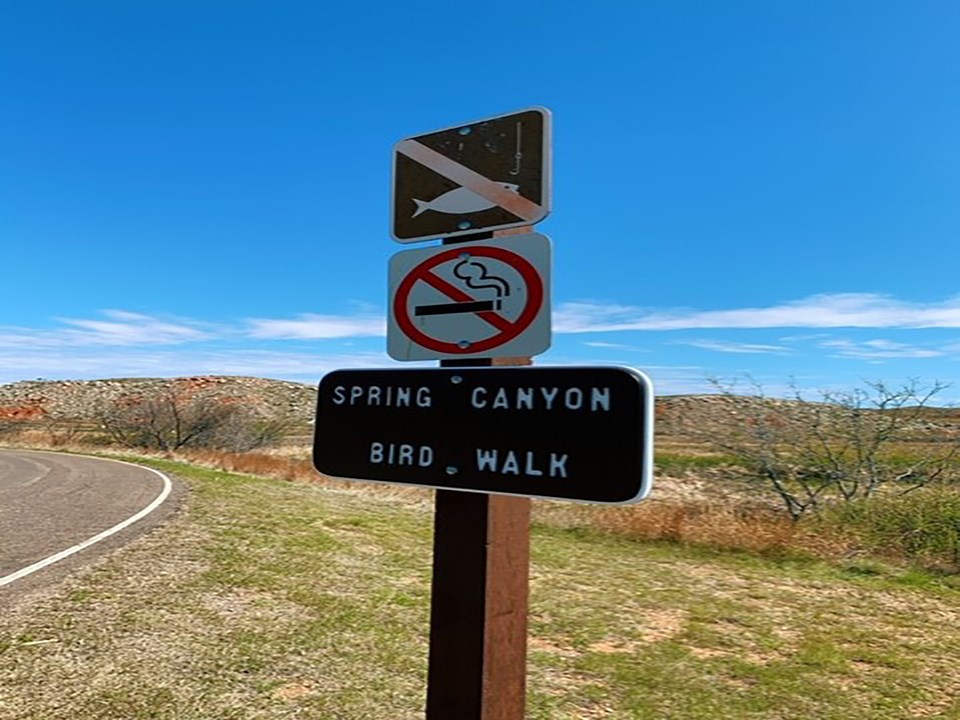
Birdwatching at Spring Canyon — a canyon in Hutchinson County, Texas — is a lesser-known subject for landscape photographers. It sits roughly 10.0 km (6.2 mi) NNE of Fritch.
From the National Park Service
When it comes to birdwatching, Spring Canyon Wetlands is the place to see and hear birds. There are over 300 species of birds migrating in and out of Lake Meredith National Recreation Area. Water plays an important part in the bird populations of Texas. Varying habitats at Lake Meredith provide shelter, food, and nesting opportunities for birds. The best viewing opportunities for waterfowl and bald eagles are during the winter. Wild Turkey, Northern Flickers, Red-tailed Hawks, and Rufous-crowned Sparrows are permanent residents. Red-headed Woodpeckers and Cassin&#’;s. Bring your binoculars, field guide, and a lawn chair and begin recording in your nature journal. A skilled ‘birder” can identify many species a day at the Spring Canyon birdwatching. A local favorite, the Great Blue Heron, frequents this area all year round.
Text: National Park Service (public domain) — nps.gov.
Sunrise & sunset directions
At Birdwatching at Spring Canyon the sunrise point swings a long way through the year: about 60° (ENE) at the June solstice and 119° (ESE) in late December. Sunset moves from 300° (WNW) in June to 241° (WSW) in December, and the midday sun climbs to 78° in summer but only 31° in winter.
| Date | Sunrise | Azimuth | Sunset | Azimuth | Noon sun | Daylight |
|---|---|---|---|---|---|---|
| March equinox (Mar 20) | 7:51 AM | 90° E | 7:58 PM | 271° W | 54° | 12h 08m |
| June solstice (Jun 21) | 6:31 AM | 60° ENE | 9:06 PM | 300° WNW | 78° | 14h 35m |
| September equinox (Sep 22) | 7:35 AM | 89° E | 7:45 PM | 271° W | 55° | 12h 10m |
| December solstice (Dec 21) | 7:53 AM | 119° ESE | 5:37 PM | 241° WSW | 31° | 9h 44m |
Azimuth is measured clockwise from true north (90° = east, 270° = west). Computed for 2026; values change by less than a degree from year to year.
Golden hour & blue hour by month
Canyons need light from above: rims glow at sunrise and sunset, while deep or narrow sections are brightest near midday when reflected light bounces off the walls.
| Month (15th) | Blue hour starts | Sunrise | Golden hour ends | Golden hour starts | Sunset | Blue hour ends | Daylight |
|---|---|---|---|---|---|---|---|
| January | 7:28 AM | 7:56 AM | 8:34 AM | 5:18 PM | 5:56 PM | 6:24 PM | 10h 00m |
| February | 7:08 AM | 7:34 AM | 8:09 AM | 5:53 PM | 6:28 PM | 6:55 PM | 10h 54m |
| March | 7:32 AM | 7:58 AM | 8:32 AM | 7:20 PM | 7:54 PM | 8:20 PM | 11h 56m |
| April | 6:48 AM | 7:14 AM | 7:48 AM | 7:45 PM | 8:20 PM | 8:46 PM | 13h 06m |
| May | 6:14 AM | 6:42 AM | 7:18 AM | 8:09 PM | 8:45 PM | 9:13 PM | 14h 03m |
| June | 6:01 AM | 6:31 AM | 7:08 AM | 8:27 PM | 9:04 PM | 9:35 PM | 14h 34m |
| July | 6:13 AM | 6:42 AM | 7:19 AM | 8:26 PM | 9:03 PM | 9:33 PM | 14h 21m |
| August | 6:39 AM | 7:06 AM | 7:41 AM | 8:02 PM | 8:37 PM | 9:04 PM | 13h 31m |
| September | 7:04 AM | 7:30 AM | 8:03 AM | 7:21 PM | 7:55 PM | 8:21 PM | 12h 25m |
| October | 7:28 AM | 7:53 AM | 8:28 AM | 6:37 PM | 7:12 PM | 7:38 PM | 11h 19m |
| November | 6:56 AM | 7:23 AM | 8:00 AM | 5:03 PM | 5:40 PM | 6:08 PM | 10h 17m |
| December | 7:21 AM | 7:50 AM | 8:29 AM | 4:55 PM | 5:35 PM | 6:03 PM | 9h 45m |
Local time (America/Chicago), including daylight saving time. Golden hour runs from about −4° to +6° solar altitude, so the morning golden hour begins during blue hour, before sunrise.
Milky Way & night sky
From Birdwatching at Spring Canyon, the Milky Way core is visible in a dark sky from February through October. June gives the longest window (about 5.7 hours on a moonless night), and the core peaks around 25° above the southern horizon. Our light-pollution model puts the sky at about Bortle 2 (typical truly dark site), which is excellent for astrophotography.
| Month | Core visible (15th) | Hours | Max altitude | Direction |
|---|---|---|---|---|
| January | Below 10° in darkness | — | -1° | — |
| February | 5:34 AM – 6:04 AM | 0.5 | 15° | SE → SE |
| March | 4:39 AM – 6:29 AM | 1.8 | 22° | SE → SSE |
| April | 2:40 AM – 5:40 AM | 3.0 | 25° | SE → S |
| May | 12:45 AM – 4:55 AM | 4.2 | 25° | SE → SSW |
| June | 10:53 PM – 4:33 AM | 5.7 | 25° | SE → SW |
| July | 10:48 PM – 3:08 AM | 4.3 | 25° | SSE → SW |
| August | 10:11 PM – 1:11 AM | 3.0 | 25° | S → SW |
| September | 9:21 PM – 11:11 PM | 1.8 | 22° | SSW → SW |
| October | 8:37 PM – 9:07 PM | 0.5 | 15° | SW → SW |
| November | Below 10° in darkness | — | 2° | — |
| December | Below 10° in darkness | — | -19° | — |
Window when the galactic core is at least 10° high during astronomical darkness on the 15th of each month. Pick nights within a few days of the new moon. Plan exact nights with the Milky Way planner.
Estimated sky darkness: 2 Bortle 2 — Typical truly dark site. The summer Milky Way shows rich structure; clouds look like black holes in the stars. Modeled zenith brightness ≈ 21.7 mag/arcsec².
Weather & best season
Long-term NASA satellite data for this area show September as the clearest month (about 36% average cloud cover) and February as the cloudiest (52%). July is the warmest month and January the coldest, which matters for gear, snow access and how long batteries last at night.
Average cloud cover (%)
| Jan | Feb | Mar | Apr | May | Jun | Jul | Aug | Sep | Oct | Nov | Dec | |
|---|---|---|---|---|---|---|---|---|---|---|---|---|
| High °F | 76 | 85 | 91 | 100 | 104 | 113 | 111 | 109 | 103 | 96 | 85 | 75 |
| Low °F | 5 | 2 | 12 | 22 | 31 | 47 | 55 | 55 | 38 | 20 | 15 | 4 |
| Precip. (in) | 0.6 | 0.7 | 1.2 | 1.6 | 2.4 | 2.9 | 2.2 | 3.0 | 1.9 | 1.9 | 0.7 | 0.6 |
Monthly climatology for the surrounding 1° grid cell from NASA POWER (MERRA-2). Mountain sites can be colder and cloudier than the cell average.
Photography tips for this canyon
- A long lens on a tripod handles the low light inside canyons better than raising ISO.
- From the rim, sunrise and sunset side-light reveals layers; a telephoto picks out buttes and shadows.
- In narrow canyons, reflected light creates orange and purple glows; avoid including bright sky in the frame.
- Check flash flood forecasts before entering slot or narrow canyons — rain miles away can flood them.
- Shoot RAW to keep the most latitude for high-contrast sunrise and sunset scenes.
Season: Spring and autumn are comfortable; summer monsoon storms bring dramatic skies but higher flood risk in the Southwest.
Suggested gear: Tripod, Wide and telephoto lenses, Lens blower, Weather radio or app. Work out exposures with the depth of field, ND filter and NPF rule calculators.
Campgrounds nearby (Recreation.gov)
- Blue West Campground8.1 km (5.1 mi)
- Chimney Hollow Campground8.8 km (5.5 mi)
- Harbor Bay Campground10.6 km (6.6 mi)
- Mcbride Canyon And Mullinaw Creek Campgrounds28 km (18 mi)
- Cedar Canyon Campground29 km (18 mi)
FAQ
When is the best time to photograph Birdwatching at Spring Canyon?
What time is golden hour at Birdwatching at Spring Canyon?
Where does the sun rise and set at Birdwatching at Spring Canyon?
Can you see the Milky Way from Birdwatching at Spring Canyon?
Do you need a permit to photograph at Birdwatching at Spring Canyon?
How far is Birdwatching at Spring Canyon from Fritch?
Sources
Location data: National Park Service. Sun, moon and Milky Way times are computed by LWPhoto Atlas for 2026. Climate: NASA POWER. Sky darkness is a population-based estimate (Walker's law), not a measurement. See data sources & licenses.