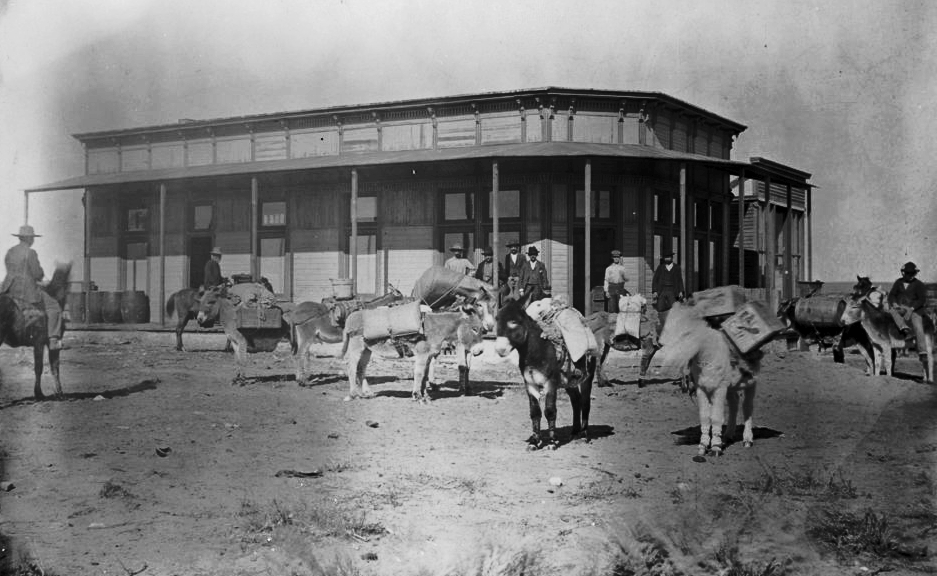
Arkalon is a ghost town in Seward County, Kansas. The nearest town is Liberal, about 15.0 km (9.3 mi) away (Arkalon lies NE of town).
Arkalon is a ghost town in Seward County, Kansas, United States. It was located northeast of Liberal on the west side of the Cimarron River.From the Wikipedia article “Arkalon, Kansas”, licensed under CC BY-SA 4.0.
Sunrise & sunset directions
At Arkalon the sunrise point swings a long way through the year: about 59° (ENE) at the June solstice and 119° (ESE) in late December. Sunset moves from 301° (WNW) in June to 241° (WSW) in December, and the midday sun climbs to 76° in summer but only 29° in winter.
| Date | Sunrise | Azimuth | Sunset | Azimuth | Noon sun | Daylight |
|---|---|---|---|---|---|---|
| March equinox (Mar 20) | 7:48 AM | 90° E | 7:55 PM | 271° W | 53° | 12h 08m |
| June solstice (Jun 21) | 6:24 AM | 59° ENE | 9:07 PM | 301° WNW | 76° | 14h 43m |
| September equinox (Sep 22) | 7:32 AM | 89° E | 7:42 PM | 271° W | 53° | 12h 10m |
| December solstice (Dec 21) | 7:54 AM | 119° ESE | 5:30 PM | 241° WSW | 29° | 9h 36m |
Azimuth is measured clockwise from true north (90° = east, 270° = west). Computed for 2026; values change by less than a degree from year to year.
Golden hour & blue hour by month
Weathered wood and rusted metal show texture best in low-angle light; overcast skies suit interiors and moody black-and-white work.
| Month (15th) | Blue hour starts | Sunrise | Golden hour ends | Golden hour starts | Sunset | Blue hour ends | Daylight |
|---|---|---|---|---|---|---|---|
| January | 7:28 AM | 7:57 AM | 8:36 AM | 5:11 PM | 5:50 PM | 6:18 PM | 9h 53m |
| February | 7:06 AM | 7:33 AM | 8:09 AM | 5:47 PM | 6:24 PM | 6:50 PM | 10h 51m |
| March | 7:29 AM | 7:55 AM | 8:30 AM | 7:16 PM | 7:51 PM | 8:17 PM | 11h 56m |
| April | 6:43 AM | 7:09 AM | 7:44 AM | 7:43 PM | 8:18 PM | 8:45 PM | 13h 09m |
| May | 6:07 AM | 6:36 AM | 7:13 AM | 8:08 PM | 8:45 PM | 9:14 PM | 14h 09m |
| June | 5:53 AM | 6:24 AM | 7:02 AM | 8:27 PM | 9:06 PM | 9:37 PM | 14h 42m |
| July | 6:06 AM | 6:36 AM | 7:14 AM | 8:26 PM | 9:04 PM | 9:34 PM | 14h 28m |
| August | 6:33 AM | 7:01 AM | 7:36 AM | 8:01 PM | 8:37 PM | 9:04 PM | 13h 36m |
| September | 7:00 AM | 7:26 AM | 8:00 AM | 7:18 PM | 7:53 PM | 8:19 PM | 12h 26m |
| October | 7:25 AM | 7:52 AM | 8:27 AM | 6:33 PM | 7:08 PM | 7:34 PM | 11h 16m |
| November | 6:55 AM | 7:23 AM | 8:01 AM | 4:56 PM | 5:35 PM | 6:02 PM | 10h 12m |
| December | 7:21 AM | 7:51 AM | 8:31 AM | 4:48 PM | 5:28 PM | 5:57 PM | 9h 38m |
Local time (America/Chicago), including daylight saving time. Golden hour runs from about −4° to +6° solar altitude, so the morning golden hour begins during blue hour, before sunrise.
Milky Way & night sky
From Arkalon, the Milky Way core is visible in a dark sky from March through September. June gives the longest window (about 5.5 hours on a moonless night), and the core peaks around 24° above the southern horizon. Our light-pollution model puts the sky at about Bortle 2 (typical truly dark site), which is excellent for astrophotography.
| Month | Core visible (15th) | Hours | Max altitude | Direction |
|---|---|---|---|---|
| January | Below 10° in darkness | — | -1° | — |
| February | 5:41 AM – 6:01 AM | 0.3 | 14° | SE → SE |
| March | 4:47 AM – 6:17 AM | 1.5 | 20° | SE → SSE |
| April | 2:50 AM – 5:30 AM | 2.7 | 24° | SE → S |
| May | 12:49 AM – 4:49 AM | 4.0 | 24° | SE → SSW |
| June | 10:59 PM – 4:29 AM | 5.5 | 24° | SE → SW |
| July | 10:53 PM – 3:03 AM | 4.2 | 24° | SSE → SW |
| August | 10:13 PM – 1:03 AM | 2.8 | 24° | S → SW |
| September | 9:21 PM – 11:01 PM | 1.7 | 20° | SSW → SW |
| October | 8:34 PM – 8:54 PM | 0.3 | 14° | SW → SW |
| November | Below 10° in darkness | — | 1° | — |
| December | Below 10° in darkness | — | -19° | — |
Window when the galactic core is at least 10° high during astronomical darkness on the 15th of each month. Pick nights within a few days of the new moon. Plan exact nights with the Milky Way planner.
Estimated sky darkness: 2 Bortle 2 — Typical truly dark site. The summer Milky Way shows rich structure; clouds look like black holes in the stars. Modeled zenith brightness ≈ 21.7 mag/arcsec².
Weather & best season
Long-term NASA satellite data for this area show September as the clearest month (about 37% average cloud cover) and February as the cloudiest (56%). July is the warmest month and January the coldest, which matters for gear, snow access and how long batteries last at night.
Average cloud cover (%)
| Jan | Feb | Mar | Apr | May | Jun | Jul | Aug | Sep | Oct | Nov | Dec | |
|---|---|---|---|---|---|---|---|---|---|---|---|---|
| High °F | 75 | 85 | 91 | 100 | 104 | 113 | 112 | 111 | 107 | 96 | 85 | 72 |
| Low °F | 1 | 1 | 6 | 20 | 31 | 45 | 55 | 51 | 36 | 19 | 13 | 3 |
| Precip. (in) | 0.5 | 0.6 | 1.1 | 2.0 | 2.8 | 3.4 | 3.1 | 3.2 | 1.7 | 1.9 | 0.6 | 0.8 |
Monthly climatology for the surrounding 1° grid cell from NASA POWER (MERRA-2). Mountain sites can be colder and cloudier than the cell average.
Photography tips for this ghost town
- Leave everything as you found it; removing artifacts from public land is illegal.
- Respect private property and closures: many ghost towns are on private land or protected historic sites — never enter unstable buildings.
- For interiors with windows, blend two exposures (one for inside, one for the view) instead of relying on HDR alone.
- Old buildings under the Milky Way make strong night images in dark rural skies.
- Look for details: door hinges, faded signs, square nails and window frames tell the story.
- Shoot RAW to keep the most latitude for high-contrast sunrise and sunset scenes.
Season: High-elevation mining towns are reachable mostly from June to October; desert ghost towns are best in spring and autumn.
Suggested gear: Wide-angle lens, Tripod, Headlamp, Sturdy boots. Work out exposures with the depth of field, ND filter and NPF rule calculators.
Permits, drones & access
Private property: Many ghost towns sit on private land or protected historic sites. Respect signs, never enter unstable buildings and leave artifacts in place.
FAQ
When is the best time to photograph Arkalon?
What time is golden hour at Arkalon?
Where does the sun rise and set at Arkalon?
Can you see the Milky Way from Arkalon?
Do you need a permit to photograph at Arkalon?
How far is Arkalon from Liberal?
Sources
Location data: Wikidata, Wikipedia. Sun, moon and Milky Way times are computed by LWPhoto Atlas for 2026. Climate: NASA POWER. Sky darkness is a population-based estimate (Walker's law), not a measurement. See data sources & licenses.