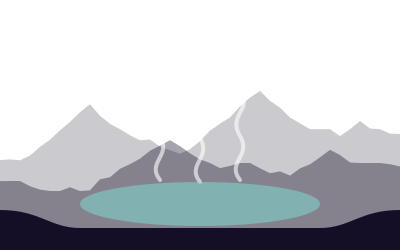
Hot Springs is a hot spring in Mineral County, Colorado at about 2,759 m (9,052 ft) above sea level. The nearest town is Pagosa Springs, about 27 km (17 mi) away (Hot Springs lies NNE of town).
Sunrise & sunset directions
At Hot Springs the sunrise point swings a long way through the year: about 59° (ENE) at the June solstice and 120° (ESE) in late December. Sunset moves from 301° (WNW) in June to 241° (WSW) in December, and the midday sun climbs to 76° in summer but only 29° in winter.
| Date | Sunrise | Azimuth | Sunset | Azimuth | Noon sun | Daylight |
|---|---|---|---|---|---|---|
| March equinox (Mar 20) | 7:12 AM | 90° E | 7:20 PM | 271° W | 52° | 12h 08m |
| June solstice (Jun 21) | 5:48 AM | 59° ENE | 8:33 PM | 301° WNW | 76° | 14h 45m |
| September equinox (Sep 22) | 6:56 AM | 89° E | 7:06 PM | 271° W | 53° | 12h 10m |
| December solstice (Dec 21) | 7:20 AM | 120° ESE | 4:54 PM | 241° WSW | 29° | 9h 34m |
Azimuth is measured clockwise from true north (90° = east, 270° = west). Computed for 2026; values change by less than a degree from year to year.
Golden hour & blue hour by month
Steam is most visible on cold mornings; backlight from a low sun makes rising steam glow.
| Month (15th) | Blue hour starts | Sunrise | Golden hour ends | Golden hour starts | Sunset | Blue hour ends | Daylight |
|---|---|---|---|---|---|---|---|
| January | 6:53 AM | 7:22 AM | 8:02 AM | 4:34 PM | 5:14 PM | 5:42 PM | 9h 52m |
| February | 6:31 AM | 6:58 AM | 7:34 AM | 5:11 PM | 5:48 PM | 6:14 PM | 10h 50m |
| March | 6:54 AM | 7:20 AM | 7:54 AM | 6:41 PM | 7:15 PM | 7:41 PM | 11h 56m |
| April | 6:07 AM | 6:34 AM | 7:09 AM | 7:08 PM | 7:43 PM | 8:10 PM | 13h 10m |
| May | 5:30 AM | 5:59 AM | 6:37 AM | 7:33 PM | 8:11 PM | 8:40 PM | 14h 11m |
| June | 5:16 AM | 5:47 AM | 6:26 AM | 7:52 PM | 8:31 PM | 9:02 PM | 14h 44m |
| July | 5:29 AM | 5:59 AM | 6:37 AM | 7:51 PM | 8:30 PM | 9:00 PM | 14h 30m |
| August | 5:57 AM | 6:25 AM | 7:00 AM | 7:26 PM | 8:02 PM | 8:30 PM | 13h 37m |
| September | 6:24 AM | 6:51 AM | 7:25 AM | 6:43 PM | 7:17 PM | 7:44 PM | 12h 27m |
| October | 6:50 AM | 7:16 AM | 7:52 AM | 5:57 PM | 6:32 PM | 6:58 PM | 11h 15m |
| November | 6:20 AM | 6:48 AM | 7:27 AM | 4:20 PM | 4:58 PM | 5:26 PM | 10h 10m |
| December | 6:47 AM | 7:16 AM | 7:57 AM | 4:11 PM | 4:52 PM | 5:21 PM | 9h 35m |
Local time (America/Denver), including daylight saving time. Golden hour runs from about −4° to +6° solar altitude, so the morning golden hour begins during blue hour, before sunrise.
Milky Way & night sky
From Hot Springs, the Milky Way core is visible in a dark sky from March through September. June gives the longest window (about 5.3 hours on a moonless night), and the core peaks around 24° above the southern horizon. Our light-pollution model puts the sky at about Bortle 1 (excellent dark-sky site), which is excellent for astrophotography.
| Month | Core visible (15th) | Hours | Max altitude | Direction |
|---|---|---|---|---|
| January | Below 10° in darkness | — | -1° | — |
| February | 5:06 AM – 5:26 AM | 0.3 | 13° | SE → SE |
| March | 4:13 AM – 5:43 AM | 1.5 | 20° | SE → SSE |
| April | 2:16 AM – 4:56 AM | 2.7 | 23° | SE → S |
| May | 12:15 AM – 4:05 AM | 3.8 | 24° | SE → S |
| June | 10:25 PM – 3:45 AM | 5.3 | 24° | SE → SSW |
| July | 10:19 PM – 2:19 AM | 4.0 | 24° | SSE → SW |
| August | 9:39 PM – 12:19 AM | 2.7 | 23° | S → SW |
| September | 8:46 PM – 10:16 PM | 1.5 | 20° | SSW → SW |
| October | 7:59 PM – 8:19 PM | 0.3 | 13° | SW → SW |
| November | Below 10° in darkness | — | 1° | — |
| December | Below 10° in darkness | — | -19° | — |
Window when the galactic core is at least 10° high during astronomical darkness on the 15th of each month. Pick nights within a few days of the new moon. Plan exact nights with the Milky Way planner.
Estimated sky darkness: 1 Bortle 1 — Excellent dark-sky site. The Milky Way casts faint shadows; zodiacal light and airglow are obvious. Modeled zenith brightness ≈ 21.92 mag/arcsec².
Weather & best season
Long-term NASA satellite data for this area show June as the clearest month (about 36% average cloud cover) and July as the cloudiest (54%). July is the warmest month and January the coldest, which matters for gear, snow access and how long batteries last at night.
Average cloud cover (%)
| Jan | Feb | Mar | Apr | May | Jun | Jul | Aug | Sep | Oct | Nov | Dec | |
|---|---|---|---|---|---|---|---|---|---|---|---|---|
| High °F | 52 | 57 | 65 | 73 | 87 | 90 | 91 | 87 | 85 | 78 | 66 | 53 |
| Low °F | -23 | -15 | -10 | 9 | 16 | 29 | 39 | 38 | 19 | 11 | -8 | -22 |
| Precip. (in) | 1.3 | 1.3 | 1.2 | 1.4 | 1.2 | 0.7 | 2.0 | 1.8 | 1.7 | 1.2 | 1.2 | 1.4 |
Monthly climatology for the surrounding 1° grid cell from NASA POWER (MERRA-2). Mountain sites can be colder and cloudier than the cell average.
Photography tips for this hot spring
- Respect bathers' privacy: ask before including people at soaking pools.
- Wind direction determines where steam drifts; shoot from the upwind side to see the pool.
- Condensation forms quickly on lenses; let gear acclimate and carry a cloth.
- Keep to boardwalks and marked paths — crusts around thermal features can be thin and the water dangerously hot.
- Check road and trail conditions with the managing agency before you go.
Season: Winter gives the most dramatic steam; some primitive springs are only accessible in summer.
Suggested gear: Circular polarizer, Lens cloth, Telephoto for distant pools. Work out exposures with the depth of field, ND filter and NPF rule calculators.
Nearby photo spots
Other locations within 25 km of Hot Springs, closest first.
 Waterfall
 Mountain Pass
 Mountain Pass
 Waterfall
 Natural Arch
Campgrounds nearby (Recreation.gov)
- West Fork Campground8.2 km (5.1 mi) · reservable
- Big Meadows Reservoir Campground (South Central Co)13.7 km (8.5 mi) · reservable
- East Fork Campground (San Juan Nf - Co)15.9 km (9.9 mi) · reservable
- Palisades Horse Camp22 km (14 mi) · reservable
- Bridge23 km (14 mi) · reservable
FAQ
When is the best time to photograph Hot Springs?
What time is golden hour at Hot Springs?
Where does the sun rise and set at Hot Springs?
Can you see the Milky Way from Hot Springs?
Do you need a permit to photograph at Hot Springs?
How far is Hot Springs from Pagosa Springs?
Sources
Location data: USGS GNIS / GeoNames. Sun, moon and Milky Way times are computed by LWPhoto Atlas for 2026. Climate: NASA POWER. Sky darkness is a population-based estimate (Walker's law), not a measurement. See data sources & licenses.