
Little Sable Point Light — a lighthouse in Oceana County, Michigan — is a classic subject for landscape photographers. It is part of Silver Lake State Park. The nearest town is Shelby, about 14.9 km (9.3 mi) away (Little Sable Point Light lies WNW of town). It dates from 1874. It is listed on the National Register of Historic Places.
The Little Sable Point Light is a lighthouse located south of Pentwater in the lower peninsula of the U.S. state of Michigan. It is in the southwest corner of Golden Township, just south of Silver Lake State Park. The lighthouse was designed by Col. Orlando M. Poe and has been described as "a classic Poe tower." The design used 109 1-foot-diameter wood pilings driven into the sand, capped by 12 feet of stone as a stout base for the brick tower. The walls of the tower are 5 feet (1.5 m) thick at the base and 2 feet (0.61 m) at its zenith.From the Wikipedia article “Little Sable Point Light”, licensed under CC BY-SA 4.0.
Sunrise & sunset directions
At Little Sable Point Light the sunrise point swings a long way through the year: about 56° (NE) at the June solstice and 123° (ESE) in late December. Sunset moves from 304° (NW) in June to 238° (WSW) in December, and the midday sun climbs to 70° in summer but only 23° in winter.
| Date | Sunrise | Azimuth | Sunset | Azimuth | Noon sun | Daylight |
|---|---|---|---|---|---|---|
| March equinox (Mar 20) | 7:50 AM | 90° E | 7:59 PM | 271° W | 46° | 12h 08m |
| June solstice (Jun 21) | 6:05 AM | 56° NE | 9:32 PM | 304° NW | 70° | 15h 27m |
| September equinox (Sep 22) | 7:34 AM | 89° E | 7:45 PM | 271° W | 47° | 12h 11m |
| December solstice (Dec 21) | 8:17 AM | 123° ESE | 5:13 PM | 238° WSW | 23° | 8h 56m |
Azimuth is measured clockwise from true north (90° = east, 270° = west). Computed for 2026; values change by less than a degree from year to year.
Golden hour & blue hour by month
Lighthouses work at both ends of the day: blue hour when the beacon is lit, and golden hour when white towers take on warm tones.
| Month (15th) | Blue hour starts | Sunrise | Golden hour ends | Golden hour starts | Sunset | Blue hour ends | Daylight |
|---|---|---|---|---|---|---|---|
| January | 7:45 AM | 8:17 AM | 9:02 AM | 4:50 PM | 5:35 PM | 6:07 PM | 9h 18m |
| February | 7:16 AM | 7:46 AM | 8:26 AM | 5:36 PM | 6:17 PM | 6:46 PM | 10h 31m |
| March | 7:31 AM | 7:59 AM | 8:37 AM | 7:15 PM | 7:53 PM | 8:21 PM | 11h 53m |
| April | 6:34 AM | 7:04 AM | 7:43 AM | 7:51 PM | 8:29 PM | 8:59 PM | 13h 25m |
| May | 5:49 AM | 6:22 AM | 7:03 AM | 8:23 PM | 9:05 PM | 9:38 PM | 14h 43m |
| June | 5:29 AM | 6:05 AM | 6:49 AM | 8:46 PM | 9:30 PM | 10:06 PM | 15h 25m |
| July | 5:44 AM | 6:19 AM | 7:02 AM | 8:44 PM | 9:26 PM | 10:01 PM | 15h 07m |
| August | 6:20 AM | 6:52 AM | 7:31 AM | 8:12 PM | 8:52 PM | 9:23 PM | 14h 00m |
| September | 6:57 AM | 7:26 AM | 8:04 AM | 7:21 PM | 7:58 PM | 8:27 PM | 12h 32m |
| October | 7:32 AM | 8:01 AM | 8:40 AM | 6:25 PM | 7:04 PM | 7:33 PM | 11h 03m |
| November | 7:10 AM | 7:41 AM | 8:24 AM | 4:39 PM | 5:22 PM | 5:53 PM | 9h 41m |
| December | 7:41 AM | 8:14 AM | 9:00 AM | 4:24 PM | 5:11 PM | 5:44 PM | 8h 57m |
Local time (America/Detroit), including daylight saving time. Golden hour runs from about −4° to +6° solar altitude, so the morning golden hour begins during blue hour, before sunrise.
Milky Way & night sky
From Little Sable Point Light, the Milky Way core is visible in a dark sky from March through September. June gives the longest window (about 3.7 hours on a moonless night), and the core peaks around 17° above the southern horizon. Our light-pollution model puts the sky at about Bortle 3 (rural sky), good enough for detailed Milky Way images.
| Month | Core visible (15th) | Hours | Max altitude | Direction |
|---|---|---|---|---|
| January | Below 10° in darkness | — | -4° | — |
| February | Below 10° in darkness | — | 8° | — |
| March | 5:38 AM – 6:18 AM | 0.7 | 14° | SSE → SSE |
| April | 3:34 AM – 5:14 AM | 1.7 | 17° | SSE → S |
| May | 1:38 AM – 4:08 AM | 2.5 | 17° | SSE → S |
| June | 11:53 PM – 3:33 AM | 3.7 | 17° | SSE → SSW |
| July | 11:40 PM – 2:20 AM | 2.7 | 17° | S → SSW |
| August | 10:43 PM – 12:13 AM | 1.5 | 16° | S → SSW |
| September | 9:37 PM – 10:17 PM | 0.7 | 14° | SSW → SSW |
| October | Below 10° in darkness | — | 8° | — |
| November | Below 10° in darkness | — | -2° | — |
| December | Below 10° in darkness | — | -19° | — |
Window when the galactic core is at least 10° high during astronomical darkness on the 15th of each month. Pick nights within a few days of the new moon. Plan exact nights with the Milky Way planner.
Estimated sky darkness: 3 Bortle 3 — Rural sky. Some light domes sit on the horizon, but the Milky Way still looks complex overhead. Modeled zenith brightness ≈ 21.59 mag/arcsec². Aurora needs roughly Kp 5.0+ to show low on the northern horizon here.
Weather & best season
Long-term NASA satellite data for this area show September as the clearest month (about 64% average cloud cover) and January as the cloudiest (85%). July is the warmest month and January the coldest, which matters for gear, snow access and how long batteries last at night.
Average cloud cover (%)
| Jan | Feb | Mar | Apr | May | Jun | Jul | Aug | Sep | Oct | Nov | Dec | |
|---|---|---|---|---|---|---|---|---|---|---|---|---|
| High °F | 50 | 53 | 71 | 69 | 81 | 85 | 91 | 88 | 85 | 78 | 66 | 58 |
| Low °F | -6 | -12 | -9 | 17 | 27 | 36 | 48 | 49 | 41 | 29 | 15 | 6 |
| Precip. (in) | 2.3 | 2.3 | 2.5 | 3.8 | 3.7 | 3.4 | 2.8 | 3.0 | 3.2 | 4.1 | 3.0 | 2.6 |
Monthly climatology for the surrounding 1° grid cell from NASA POWER (MERRA-2). Mountain sites can be colder and cloudier than the cell average.
Photography tips for this lighthouse
- Many lighthouses are on private or Coast Guard property — check public access and opening hours.
- Moonrise or the Milky Way over the tower makes a classic night composition; plan with the azimuth tables.
- During blue hour, use 5–15 second exposures to capture the beam; check whether the light is still active.
- Shoot from the beach or a jetty to place the tower against open sky and sea.
- Tell someone where you're going in remote areas and carry the ten essentials.
Season: Summer brings open towers and tours; autumn and winter offer storms, fewer crowds and lower sun angles.
Suggested gear: Tripod, Telephoto lens, ND filter for smooth water, Rain cover. Work out exposures with the depth of field, ND filter and NPF rule calculators.
Permits, drones & access
Drones: Drone rules in state parks vary by state and even by park — many require a permit or ban recreational drone flights. Check the park's rules and the FAA B4UFLY app before flying.
Nearby photo spots
Other locations within 25 km of Little Sable Point Light, closest first.
 Sand Dunes
 State Park
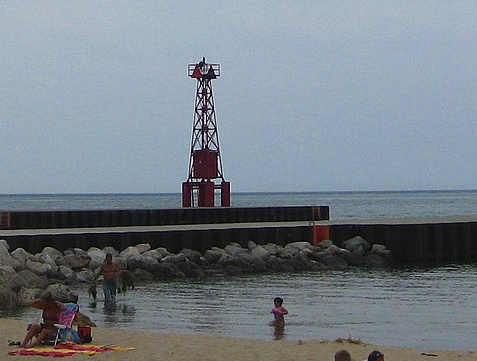 Lighthouse
 Lighthouse
 Lighthouse
 State Park
FAQ
When is the best time to photograph Little Sable Point Light?
What time is golden hour at Little Sable Point Light?
Where does the sun rise and set at Little Sable Point Light?
Can you see the Milky Way from Little Sable Point Light?
Do you need a permit to photograph at Little Sable Point Light?
How far is Little Sable Point Light from Shelby?
Sources
Location data: Wikidata, Wikipedia. Sun, moon and Milky Way times are computed by LWPhoto Atlas for 2026. Climate: NASA POWER. Sky darkness is a population-based estimate (Walker's law), not a measurement. See data sources & licenses.