The Phallus is a rock formation in Grand County, Utah. It lies in or next to Arches National Park, so park hours, fees and rules apply. It sits roughly 12.6 km (7.8 mi) NNW of Moab.
The Phallus is a rock formation (pillar) in Grand County, Utah, in the United States. It is within the Arches National Park. The Phallus stands 100 feet (30 m) tall, and was named from the fact it resembles a phallus. A climbing route has been published in guidebooks.From the Wikipedia article “The Phallus”, licensed under CC BY-SA 4.0.
Sunrise & sunset directions
At The Phallus the sunrise point swings a long way through the year: about 59° (ENE) at the June solstice and 120° (ESE) in late December. Sunset moves from 302° (WNW) in June to 240° (WSW) in December, and the midday sun climbs to 75° in summer but only 28° in winter.
| Date | Sunrise | Azimuth | Sunset | Azimuth | Noon sun | Daylight |
|---|---|---|---|---|---|---|
| March equinox (Mar 20) | 7:23 AM | 90° E | 7:31 PM | 271° W | 51° | 12h 08m |
| June solstice (Jun 21) | 5:55 AM | 59° ENE | 8:47 PM | 302° WNW | 75° | 14h 52m |
| September equinox (Sep 22) | 7:07 AM | 89° E | 7:17 PM | 271° W | 52° | 12h 10m |
| December solstice (Dec 21) | 7:34 AM | 120° ESE | 5:01 PM | 240° WSW | 28° | 9h 27m |
Azimuth is measured clockwise from true north (90° = east, 270° = west). Computed for 2026; values change by less than a degree from year to year.
Golden hour & blue hour by month
Rock towers and buttes glow red and orange in the first and last half-hour of sun; midday light flattens their shape.
| Month (15th) | Blue hour starts | Sunrise | Golden hour ends | Golden hour starts | Sunset | Blue hour ends | Daylight |
|---|---|---|---|---|---|---|---|
| January | 7:06 AM | 7:36 AM | 8:16 AM | 4:41 PM | 5:21 PM | 5:50 PM | 9h 46m |
| February | 6:43 AM | 7:10 AM | 7:47 AM | 5:20 PM | 5:57 PM | 6:24 PM | 10h 46m |
| March | 7:04 AM | 7:30 AM | 8:06 AM | 6:51 PM | 7:26 PM | 7:52 PM | 11h 55m |
| April | 6:15 AM | 6:43 AM | 7:18 AM | 7:20 PM | 7:55 PM | 8:23 PM | 13h 12m |
| May | 5:37 AM | 6:07 AM | 6:45 AM | 7:46 PM | 8:24 PM | 8:54 PM | 14h 17m |
| June | 5:22 AM | 5:54 AM | 6:34 AM | 8:06 PM | 8:45 PM | 9:17 PM | 14h 51m |
| July | 5:36 AM | 6:06 AM | 6:45 AM | 8:04 PM | 8:43 PM | 9:14 PM | 14h 37m |
| August | 6:05 AM | 6:33 AM | 7:10 AM | 7:38 PM | 8:14 PM | 8:43 PM | 13h 41m |
| September | 6:34 AM | 7:01 AM | 7:36 AM | 6:53 PM | 7:28 PM | 7:55 PM | 12h 28m |
| October | 7:01 AM | 7:28 AM | 8:04 AM | 6:05 PM | 6:41 PM | 7:08 PM | 11h 13m |
| November | 6:33 AM | 7:01 AM | 7:41 AM | 4:27 PM | 5:06 PM | 5:35 PM | 10h 05m |
| December | 7:00 AM | 7:30 AM | 8:12 AM | 4:17 PM | 4:59 PM | 5:29 PM | 9h 29m |
Local time (America/Denver), including daylight saving time. Golden hour runs from about −4° to +6° solar altitude, so the morning golden hour begins during blue hour, before sunrise.
Milky Way & night sky
From The Phallus, the Milky Way core is visible in a dark sky from March through September. June gives the longest window (about 5.2 hours on a moonless night), and the core peaks around 22° above the southern horizon. Our light-pollution model puts the sky at about Bortle 2 (typical truly dark site), which is excellent for astrophotography.
| Month | Core visible (15th) | Hours | Max altitude | Direction |
|---|---|---|---|---|
| January | Below 10° in darkness | — | -2° | — |
| February | 5:25 AM – 5:35 AM | 0.2 | 12° | SE → SE |
| March | 4:34 AM – 5:54 AM | 1.3 | 19° | SE → SSE |
| April | 2:30 AM – 5:00 AM | 2.5 | 22° | SE → S |
| May | 12:31 AM – 4:11 AM | 3.7 | 22° | SE → S |
| June | 10:43 PM – 3:53 AM | 5.2 | 22° | SE → SSW |
| July | 10:36 PM – 2:26 AM | 3.8 | 22° | SSE → SW |
| August | 9:53 PM – 12:23 AM | 2.5 | 22° | S → SW |
| September | 8:58 PM – 10:18 PM | 1.3 | 19° | SSW → SW |
| October | 8:09 PM – 8:29 PM | 0.3 | 12° | SW → SW |
| November | Below 10° in darkness | — | 0° | — |
| December | Below 10° in darkness | — | -19° | — |
Window when the galactic core is at least 10° high during astronomical darkness on the 15th of each month. Pick nights within a few days of the new moon. Plan exact nights with the Milky Way planner.
Estimated sky darkness: 2 Bortle 2 — Typical truly dark site. The summer Milky Way shows rich structure; clouds look like black holes in the stars. Modeled zenith brightness ≈ 21.83 mag/arcsec².
Weather & best season
Long-term NASA satellite data for this area show June as the clearest month (about 31% average cloud cover) and December as the cloudiest (56%). July is the warmest month and January the coldest, which matters for gear, snow access and how long batteries last at night.
Average cloud cover (%)
| Jan | Feb | Mar | Apr | May | Jun | Jul | Aug | Sep | Oct | Nov | Dec | |
|---|---|---|---|---|---|---|---|---|---|---|---|---|
| High °F | 59 | 62 | 77 | 85 | 98 | 102 | 104 | 100 | 98 | 87 | 73 | 59 |
| Low °F | -7 | -8 | 8 | 18 | 22 | 34 | 48 | 47 | 32 | 7 | 8 | -4 |
| Precip. (in) | 0.8 | 1.0 | 1.0 | 0.8 | 0.8 | 0.5 | 1.2 | 1.2 | 1.3 | 1.2 | 0.8 | 1.1 |
Monthly climatology for the surrounding 1° grid cell from NASA POWER (MERRA-2). Mountain sites can be colder and cloudier than the cell average.
Photography tips for this rock formation
- At night, a formation under the Milky Way or star trails makes a strong anchor.
- Use the sunrise and sunset azimuths below to know which face will be lit.
- Stay on trails; desert soils and lichens take decades to recover from footprints.
- Find a spot where the formation sits against open sky to emphasize its silhouette.
- Scout in daylight if you plan to shoot at night or before sunrise.
Season: Spring and autumn are best in desert regions; winter snow on red rock is rare but spectacular.
Suggested gear: Wide and telephoto lenses, Tripod, Headlamp. Work out exposures with the depth of field, ND filter and NPF rule calculators.
Permits, drones & access
National Park Service rules. Under federal law (54 U.S.C. 100905), still photography in National Park Service areas needs a permit only when it (1) takes place where members of the public are not allowed, (2) uses models, sets or props that are not part of the location's natural or cultural resources or administrative facilities, or (3) would cause the park to incur additional administrative costs to monitor the activity. Ordinary visitor and most landscape photography needs no permit. Commercial filming rules are separate and have changed in recent years — confirm current requirements with the park before a paid shoot.
Drones: Launching, landing or operating unmanned aircraft (drones) is prohibited in National Park Service units under a 2014 Superintendent's closure (36 CFR 1.5), except where a park has issued specific written approval. Flying from outside the boundary over park land can also violate park rules and disturb wildlife.
Nearby photo spots
Other locations within 25 km of The Phallus, closest first.
 Natural ArchNatural ArchNatural Arch
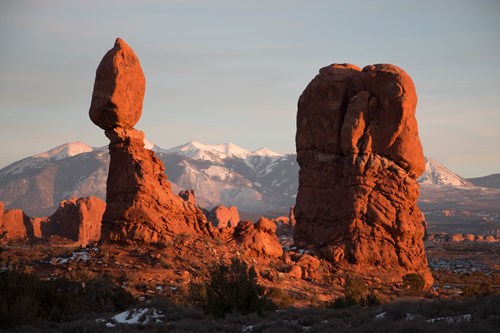 Scenic ViewpointNatural ArchNatural Arch
 Natural ArchNatural ArchNatural Arch
Campgrounds nearby (Recreation.gov)
- 8.5 km (5.3 mi) · reservable
- Goose Island Campground8.5 km (5.3 mi)
- Goose Island Group Sites8.5 km (5.3 mi) · reservable
- 9.1 km (5.7 mi) · reservable
- Upper Big Bend Campground9.2 km (5.7 mi)
FAQ
When is the best time to photograph The Phallus?
What time is golden hour at The Phallus?
Where does the sun rise and set at The Phallus?
Can you see the Milky Way from The Phallus?
Do you need a permit to photograph at The Phallus?
How far is The Phallus from Moab?
Sources
Location data: Wikidata, Wikipedia. Sun, moon and Milky Way times are computed by LWPhoto Atlas for 2026. Climate: NASA POWER. Sky darkness is a population-based estimate (Walker's law), not a measurement. See data sources & licenses.