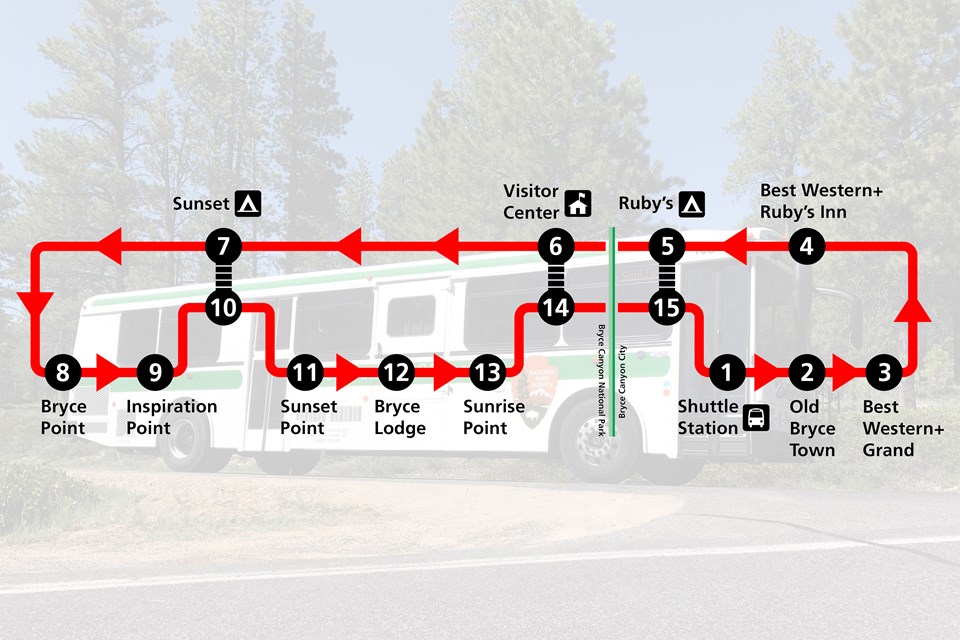
Bryce Canyon Shuttle Station is a canyon in Garfield County, Utah. It lies in or next to Bryce Canyon National Park, so park hours, fees and rules apply. The nearest town is Panguitch, about 30 km (19 mi) away (Bryce Canyon Shuttle Station lies SE of town).
From the National Park Service
The shuttle station is the hub for the free Bryce Amphitheater shuttle. Purchase a digital pass before you arrive and simply show it to the driver when you board. Now You Can Track the Shuttle! Buses typically come every 15 minutes from 8 am to 6 pm in Spring and Fall and until 8 pm in summer, but with the new Bryce Canyon Shuttle Tracker you can time your next ride to the minute. Riding the Free Bryce Canyon Shuttle Bryce Canyon is one of many busy national parks that has a mass transit system to minimize vehicle congestion and the resulting impacts that jeopardize the very things we all treasure about national parks. With the exception of vehicles measuring 23 feet/7 meters or longer, which are restricted from the Bryce Amphitheater during shuttle hours, riding the shuttle is not mandatory. However, by riding our buses you will support our efforts to keep our parking lots from growing any larger, to keep our pure air as clean as possible, and to provide enough room in our little park for everyone to experience the magic of Bryce Canyon.
The Bryce Amphitheater Shuttle runs regularly on 15 minute intervals from 8 a.m. to 6 p.m. with extended hours to 8 p.m. in summer, and brings visitors to areas of interest, viewpoints, and trailheads within the Bryce Amphitheater area of the park. The shuttle is free with park admission. How to use the Shuttle There is no extra fee to use the shuttle system. Paying your entrance fee to Bryce Canyon entitles you and your vehicle's occupants to unlimited use of the Bryce Canyon Shuttle buses.
Annual Passes waive the entrance fee to not only this park but all other National Park Service Areas and other Federal lands that may have fees, across the entire country. If you do not already have one of these annual passes they can be purchased at the entrance to the park.
If you are not staying overnight inside the park at either the Bryce Canyon Lodge or North or Sunset Campground, we strongly encourage you to leave your vehicle outside the park. Please park and board the shuttle at the Shuttle Station (near Ruby's Inn, on the left side of the road before entering the park) or at Ruby's Campground.
Text: National Park Service (public domain) — nps.gov.
Sunrise & sunset directions
At Bryce Canyon Shuttle Station the sunrise point swings a long way through the year: about 59° (ENE) at the June solstice and 120° (ESE) in late December. Sunset moves from 301° (WNW) in June to 241° (WSW) in December, and the midday sun climbs to 76° in summer but only 29° in winter.
| Date | Sunrise | Azimuth | Sunset | Azimuth | Noon sun | Daylight |
|---|---|---|---|---|---|---|
| March equinox (Mar 20) | 7:33 AM | 90° E | 7:41 PM | 271° W | 52° | 12h 08m |
| June solstice (Jun 21) | 6:08 AM | 59° ENE | 8:54 PM | 301° WNW | 76° | 14h 46m |
| September equinox (Sep 22) | 7:17 AM | 89° E | 7:27 PM | 271° W | 53° | 12h 10m |
| December solstice (Dec 21) | 7:41 AM | 120° ESE | 5:14 PM | 241° WSW | 29° | 9h 33m |
Azimuth is measured clockwise from true north (90° = east, 270° = west). Computed for 2026; values change by less than a degree from year to year.
Golden hour & blue hour by month
Canyons need light from above: rims glow at sunrise and sunset, while deep or narrow sections are brightest near midday when reflected light bounces off the walls.
| Month (15th) | Blue hour starts | Sunrise | Golden hour ends | Golden hour starts | Sunset | Blue hour ends | Daylight |
|---|---|---|---|---|---|---|---|
| January | 7:15 AM | 7:43 AM | 8:23 AM | 4:54 PM | 5:34 PM | 6:03 PM | 9h 51m |
| February | 6:52 AM | 7:19 AM | 7:56 AM | 5:32 PM | 6:08 PM | 6:35 PM | 10h 49m |
| March | 7:14 AM | 7:41 AM | 8:15 AM | 7:02 PM | 7:36 PM | 8:02 PM | 11h 56m |
| April | 6:27 AM | 6:54 AM | 7:29 AM | 7:29 PM | 8:04 PM | 8:31 PM | 13h 10m |
| May | 5:51 AM | 6:20 AM | 6:57 AM | 7:55 PM | 8:32 PM | 9:01 PM | 14h 12m |
| June | 5:36 AM | 6:07 AM | 6:46 AM | 8:14 PM | 8:53 PM | 9:24 PM | 14h 45m |
| July | 5:49 AM | 6:20 AM | 6:58 AM | 8:13 PM | 8:51 PM | 9:21 PM | 14h 31m |
| August | 6:17 AM | 6:45 AM | 7:21 AM | 7:47 PM | 8:23 PM | 8:51 PM | 13h 38m |
| September | 6:45 AM | 7:11 AM | 7:46 AM | 7:04 PM | 7:38 PM | 8:04 PM | 12h 27m |
| October | 7:11 AM | 7:37 AM | 8:13 AM | 6:17 PM | 6:53 PM | 7:19 PM | 11h 15m |
| November | 6:42 AM | 7:10 AM | 7:48 AM | 4:40 PM | 5:19 PM | 5:47 PM | 10h 09m |
| December | 7:08 AM | 7:37 AM | 8:18 AM | 4:31 PM | 5:12 PM | 5:41 PM | 9h 35m |
Local time (America/Denver), including daylight saving time. Golden hour runs from about −4° to +6° solar altitude, so the morning golden hour begins during blue hour, before sunrise.
Milky Way & night sky
From Bryce Canyon Shuttle Station, the Milky Way core is visible in a dark sky from March through September. June gives the longest window (about 5.3 hours on a moonless night), and the core peaks around 23° above the southern horizon. Our light-pollution model puts the sky at about Bortle 1 (excellent dark-sky site), which is excellent for astrophotography.
| Month | Core visible (15th) | Hours | Max altitude | Direction |
|---|---|---|---|---|
| January | Below 10° in darkness | — | -1° | — |
| February | 5:27 AM – 5:47 AM | 0.3 | 13° | SE → SE |
| March | 4:34 AM – 6:04 AM | 1.5 | 20° | SE → SSE |
| April | 2:38 AM – 5:18 AM | 2.7 | 23° | SE → S |
| May | 12:37 AM – 4:27 AM | 3.8 | 23° | SE → S |
| June | 10:48 PM – 4:08 AM | 5.3 | 23° | SE → SW |
| July | 10:41 PM – 2:41 AM | 4.0 | 23° | SSE → SW |
| August | 10:01 PM – 12:41 AM | 2.7 | 23° | S → SW |
| September | 9:07 PM – 10:37 PM | 1.5 | 20° | SSW → SW |
| October | 8:20 PM – 8:40 PM | 0.3 | 13° | SW → SW |
| November | Below 10° in darkness | — | 1° | — |
| December | Below 10° in darkness | — | -19° | — |
Window when the galactic core is at least 10° high during astronomical darkness on the 15th of each month. Pick nights within a few days of the new moon. Plan exact nights with the Milky Way planner.
Estimated sky darkness: 1 Bortle 1 — Excellent dark-sky site. The Milky Way casts faint shadows; zodiacal light and airglow are obvious. Modeled zenith brightness ≈ 21.93 mag/arcsec².
Weather & best season
Long-term NASA satellite data for this area show June as the clearest month (about 26% average cloud cover) and February as the cloudiest (52%). July is the warmest month and December the coldest, which matters for gear, snow access and how long batteries last at night.
Average cloud cover (%)
| Jan | Feb | Mar | Apr | May | Jun | Jul | Aug | Sep | Oct | Nov | Dec | |
|---|---|---|---|---|---|---|---|---|---|---|---|---|
| High °F | 60 | 64 | 72 | 80 | 90 | 97 | 98 | 96 | 94 | 81 | 70 | 57 |
| Low °F | -11 | -7 | 0 | 16 | 21 | 29 | 44 | 41 | 25 | 10 | 0 | -11 |
| Precip. (in) | 1.2 | 1.4 | 1.1 | 1.0 | 0.7 | 0.4 | 1.4 | 1.4 | 1.2 | 1.3 | 1.0 | 1.2 |
Monthly climatology for the surrounding 1° grid cell from NASA POWER (MERRA-2). Mountain sites can be colder and cloudier than the cell average.
Photography tips for this canyon
- In narrow canyons, reflected light creates orange and purple glows; avoid including bright sky in the frame.
- Check flash flood forecasts before entering slot or narrow canyons — rain miles away can flood them.
- Dust and sand are hard on gear; change lenses in a bag or with your back to the wind.
- A long lens on a tripod handles the low light inside canyons better than raising ISO.
- From the rim, sunrise and sunset side-light reveals layers; a telephoto picks out buttes and shadows.
- Tell someone where you're going in remote areas and carry the ten essentials.
Season: Spring and autumn are comfortable; summer monsoon storms bring dramatic skies but higher flood risk in the Southwest.
Suggested gear: Tripod, Wide and telephoto lenses, Lens blower, Weather radio or app. Work out exposures with the depth of field, ND filter and NPF rule calculators.
Permits, drones & access
National Park Service rules. Under federal law (54 U.S.C. 100905), still photography in National Park Service areas needs a permit only when it (1) takes place where members of the public are not allowed, (2) uses models, sets or props that are not part of the location's natural or cultural resources or administrative facilities, or (3) would cause the park to incur additional administrative costs to monitor the activity. Ordinary visitor and most landscape photography needs no permit. Commercial filming rules are separate and have changed in recent years — confirm current requirements with the park before a paid shoot.
Drones: Launching, landing or operating unmanned aircraft (drones) is prohibited in National Park Service units under a 2014 Superintendent's closure (36 CFR 1.5), except where a park has issued specific written approval. Flying from outside the boundary over park land can also violate park rules and disturb wildlife.
Nearby photo spots
Other locations within 25 km of Bryce Canyon Shuttle Station, closest first.
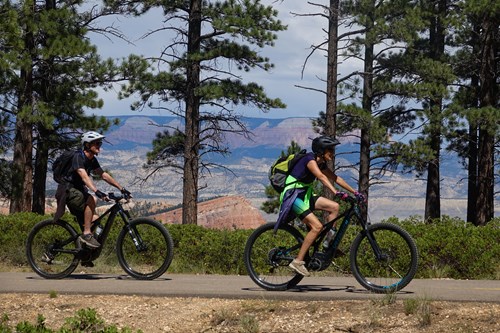 Canyon
 Scenic Viewpoint
 Dark Sky Place
 Waterfall
 Canyon
 Natural ArchScenic ViewpointScenic Viewpoint
 Natural Arch
Campgrounds nearby (Recreation.gov)
- North Campground3.8 km (2.4 mi)
- North Campground (Ut)4.2 km (2.6 mi) · reservable
- Sunset Campground (Ut)4.2 km (2.6 mi) · reservable
- Kings Creek11.3 km (7.1 mi) · reservable
- Pine Lake Campground19.8 km (12.3 mi) · reservable
FAQ
When is the best time to photograph Bryce Canyon Shuttle Station?
What time is golden hour at Bryce Canyon Shuttle Station?
Where does the sun rise and set at Bryce Canyon Shuttle Station?
Can you see the Milky Way from Bryce Canyon Shuttle Station?
Do you need a permit to photograph at Bryce Canyon Shuttle Station?
How far is Bryce Canyon Shuttle Station from Panguitch?
Sources
Location data: National Park Service. Sun, moon and Milky Way times are computed by LWPhoto Atlas for 2026. Climate: NASA POWER. Sky darkness is a population-based estimate (Walker's law), not a measurement. See data sources & licenses.