
Located in Kodiak Island Borough, Alaska, Mount Kukak is a mountain peak. The nearest town is Kodiak, about 136 km (85 mi) away (Mount Kukak lies WNW of town).
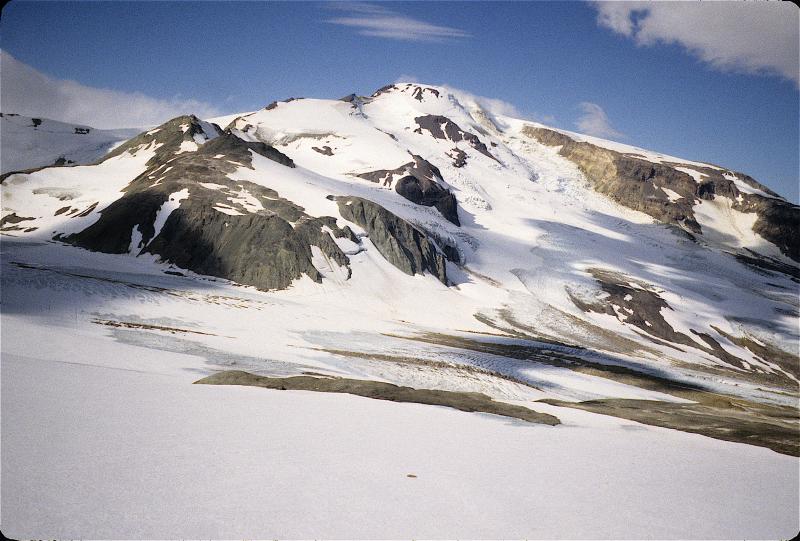
Mount Kukak is an almost completely ice-covered stratovolcano on the Alaska Peninsula of Alaska, United States. Although the last eruption from Mount Kukak is unknown, it displays vigorous fumarolic activity.From the Wikipedia article “Mount Kukak”, licensed under CC BY-SA 4.0.
Sunrise & sunset directions
At Mount Kukak the sunrise point swings a long way through the year: about 39° (NE) at the June solstice and 138° (SE) in late December. Sunset moves from 322° (NW) in June to 223° (SW) in December, and the midday sun climbs to 55° in summer but only 8° in winter.
| Date | Sunrise | Azimuth | Sunset | Azimuth | Noon sun | Daylight |
|---|---|---|---|---|---|---|
| March equinox (Mar 20) | 8:20 AM | 89° E | 8:32 PM | 272° W | 32° | 12h 12m |
| June solstice (Jun 21) | 5:10 AM | 39° NE | 11:30 PM | 322° NW | 55° | 18h 19m |
| September equinox (Sep 22) | 8:03 AM | 88° E | 8:19 PM | 272° W | 32° | 12h 16m |
| December solstice (Dec 21) | 10:06 AM | 138° SE | 4:26 PM | 223° SW | 8° | 6h 20m |
Azimuth is measured clockwise from true north (90° = east, 270° = west). Computed for 2026; values change by less than a degree from year to year.
Golden hour & blue hour by month
Summits catch first and last light — alpenglow can turn rock pink or orange minutes before sunrise and after sunset while valleys stay in shadow.
| Month (15th) | Blue hour starts | Sunrise | Golden hour ends | Golden hour starts | Sunset | Blue hour ends | Daylight |
|---|---|---|---|---|---|---|---|
| January | 9:05 AM | 9:54 AM | 11:17 AM | 3:38 PM | 5:01 PM | 5:50 PM | 7h 06m |
| February | 8:09 AM | 8:51 AM | 9:51 AM | 5:14 PM | 6:14 PM | 6:56 PM | 9h 23m |
| March | 7:54 AM | 8:34 AM | 9:27 AM | 7:27 PM | 8:20 PM | 9:00 PM | 11h 46m |
| April | 6:22 AM | 7:05 AM | 8:00 AM | 8:36 PM | 9:31 PM | 10:14 PM | 14h 25m |
| May | 4:53 AM | 5:51 AM | 6:53 AM | 9:36 PM | 10:39 PM | 11:36 PM | 16h 48m |
| June | 3:51 AM | 5:10 AM | 6:23 AM | 10:15 PM | 11:27 PM | 12:46 AM | 18h 17m |
| July | 4:29 AM | 5:35 AM | 6:43 AM | 10:05 PM | 11:13 PM | 12:19 AM | 17h 37m |
| August | 5:52 AM | 6:40 AM | 7:37 AM | 9:09 PM | 10:06 PM | 10:53 PM | 15h 26m |
| September | 7:08 AM | 7:48 AM | 8:40 AM | 7:47 PM | 8:39 PM | 9:19 PM | 12h 51m |
| October | 8:14 AM | 8:54 AM | 9:50 AM | 6:17 PM | 7:13 PM | 7:54 PM | 10h 19m |
| November | 8:21 AM | 9:08 AM | 10:20 AM | 3:46 PM | 4:58 PM | 5:45 PM | 7h 51m |
| December | 9:09 AM | 10:02 AM | 11:40 AM | 2:47 PM | 4:25 PM | 5:18 PM | 6h 23m |
Local time (America/Anchorage), including daylight saving time. Golden hour runs from about −4° to +6° solar altitude, so the morning golden hour begins during blue hour, before sunrise.
Milky Way & night sky
The Milky Way's bright core (in Sagittarius) barely clears the southern horizon at this latitude, so focus on winter Milky Way, aurora or star trails instead.
| Month | Core visible (15th) | Hours | Max altitude | Direction |
|---|---|---|---|---|
| January | Below 10° in darkness | — | -11° | — |
| February | Below 10° in darkness | — | -4° | — |
| March | Below 10° in darkness | — | -2° | — |
| April | Below 10° in darkness | — | -3° | — |
| May | Below 10° in darkness | — | 0° | — |
| June | No darkness | — | — | — |
| July | No darkness | — | — | — |
| August | Below 10° in darkness | — | 0° | — |
| September | Below 10° in darkness | — | -4° | — |
| October | Below 10° in darkness | — | -5° | — |
| November | Below 10° in darkness | — | -10° | — |
| December | Below 10° in darkness | — | -21° | — |
Window when the galactic core is at least 10° high during astronomical darkness on the 15th of each month. Pick nights within a few days of the new moon. Plan exact nights with the Milky Way planner.
Estimated sky darkness: 1 Bortle 1 — Excellent dark-sky site. The Milky Way casts faint shadows; zodiacal light and airglow are obvious. Modeled zenith brightness ≈ 21.95 mag/arcsec². Aurora needs roughly Kp 2.0+ to show low on the northern horizon here.
Weather & best season
Long-term NASA satellite data for this area show March as the clearest month (about 65% average cloud cover) and July as the cloudiest (82%). July is the warmest month and January the coldest, which matters for gear, snow access and how long batteries last at night.
Average cloud cover (%)
| Jan | Feb | Mar | Apr | May | Jun | Jul | Aug | Sep | Oct | Nov | Dec | |
|---|---|---|---|---|---|---|---|---|---|---|---|---|
| High °F | 39 | 38 | 40 | 57 | 69 | 73 | 78 | 76 | 66 | 52 | 46 | 41 |
| Low °F | -23 | -18 | -16 | -2 | 13 | 36 | 40 | 37 | 27 | 2 | -18 | -19 |
| Precip. (in) | 5.3 | 5.0 | 3.2 | 3.9 | 3.9 | 3.7 | 3.9 | 4.7 | 5.9 | 5.7 | 5.0 | 6.1 |
Monthly climatology for the surrounding 1° grid cell from NASA POWER (MERRA-2). Mountain sites can be colder and cloudier than the cell average.
Photography tips for this mountain peak
- Long lenses compress ridgelines; shoot the peak from several miles away to make it look massive.
- Afternoon thunderstorms are common in summer at high elevations — plan summit hikes for early morning.
- Snow on the summit holds detail best when you expose for the highlights and lift shadows later.
- Alpenglow lasts only a few minutes; set up and focus beforehand.
- Clouds around the summit add drama — a clear blue sky is often the least interesting condition.
- Bring a spare battery — cold weather and long exposures drain them fast.
Season: Early summer keeps snow on the peaks with green valleys below; autumn adds aspen or larch color in many ranges.
Suggested gear: Telephoto lens, Lightweight tripod, Warm layers, Microspikes in shoulder seasons. Work out exposures with the depth of field, ND filter and NPF rule calculators.
Nearby photo spots
Other locations within 25 km of Mount Kukak, closest first.
 Mountain Peak
 Mountain PeakMountain Peak
 Mountain Peak
 Waterfall
FAQ
When is the best time to photograph Mount Kukak?
What time is golden hour at Mount Kukak?
Where does the sun rise and set at Mount Kukak?
Can you see the Milky Way from Mount Kukak?
Do you need a permit to photograph at Mount Kukak?
How far is Mount Kukak from Kodiak?
Sources
Location data: Wikidata, Wikipedia. Sun, moon and Milky Way times are computed by LWPhoto Atlas for 2026. Climate: NASA POWER. Sky darkness is a population-based estimate (Walker's law), not a measurement. See data sources & licenses.