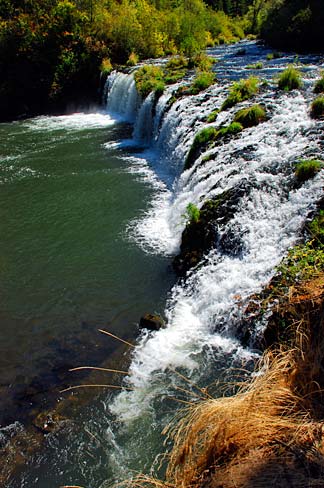
Big Butte Creek Falls — a waterfall in Jackson County, Oregon — is a popular subject for landscape photographers. It sits roughly 21 km (13 mi) ENE of Eagle Point.
Butte Falls is a waterfall located near the town of Butte Falls in Jackson County, in the U.S. state of Oregon. It totals 15 feet (4.6 m) tall in one wide cascade and is runnable by whitewater kayak on the right side shooting into a large bowl. In the past, the waterfall was the site of a water-driven sawmill that led to the town of Butte Falls.From the Wikipedia article “Butte Falls (Jackson County, Oregon)”, licensed under CC BY-SA 4.0.
Sunrise & sunset directions
At Big Butte Creek Falls the sunrise point swings a long way through the year: about 57° (ENE) at the June solstice and 122° (ESE) in late December. Sunset moves from 304° (NW) in June to 238° (WSW) in December, and the midday sun climbs to 71° in summer but only 24° in winter.
| Date | Sunrise | Azimuth | Sunset | Azimuth | Noon sun | Daylight |
|---|---|---|---|---|---|---|
| March equinox (Mar 20) | 7:14 AM | 90° E | 7:23 PM | 271° W | 47° | 12h 08m |
| June solstice (Jun 21) | 5:34 AM | 57° ENE | 8:52 PM | 304° NW | 71° | 15h 18m |
| September equinox (Sep 22) | 6:58 AM | 89° E | 7:09 PM | 271° W | 48° | 12h 11m |
| December solstice (Dec 21) | 7:38 AM | 122° ESE | 4:41 PM | 238° WSW | 24° | 9h 03m |
Azimuth is measured clockwise from true north (90° = east, 270° = west). Computed for 2026; values change by less than a degree from year to year.
Golden hour & blue hour by month
Waterfalls photograph best in soft, even light: overcast days, deep shade, or the hour after sunrise before direct sun hits the water. Bright sun on white water blows highlights and adds harsh contrast.
| Month (15th) | Blue hour starts | Sunrise | Golden hour ends | Golden hour starts | Sunset | Blue hour ends | Daylight |
|---|---|---|---|---|---|---|---|
| January | 7:07 AM | 7:38 AM | 8:22 AM | 4:19 PM | 5:03 PM | 5:34 PM | 9h 24m |
| February | 6:39 AM | 7:08 AM | 7:47 AM | 5:03 PM | 5:43 PM | 6:12 PM | 10h 35m |
| March | 6:55 AM | 7:23 AM | 8:00 AM | 6:40 PM | 7:17 PM | 7:45 PM | 11h 54m |
| April | 6:00 AM | 6:30 AM | 7:07 AM | 7:14 PM | 7:52 PM | 8:21 PM | 13h 23m |
| May | 5:17 AM | 5:49 AM | 6:30 AM | 7:45 PM | 8:26 PM | 8:58 PM | 14h 37m |
| June | 4:58 AM | 5:33 AM | 6:16 AM | 8:07 PM | 8:50 PM | 9:25 PM | 15h 17m |
| July | 5:13 AM | 5:47 AM | 6:29 AM | 8:05 PM | 8:47 PM | 9:21 PM | 15h 00m |
| August | 5:48 AM | 6:18 AM | 6:57 AM | 7:35 PM | 8:13 PM | 8:44 PM | 13h 55m |
| September | 6:23 AM | 6:51 AM | 7:28 AM | 6:45 PM | 7:22 PM | 7:50 PM | 12h 31m |
| October | 6:55 AM | 7:24 AM | 8:02 AM | 5:51 PM | 6:29 PM | 6:58 PM | 11h 06m |
| November | 6:32 AM | 7:02 AM | 7:45 AM | 4:07 PM | 4:49 PM | 5:19 PM | 9h 47m |
| December | 7:02 AM | 7:34 AM | 8:20 AM | 3:53 PM | 4:39 PM | 5:11 PM | 9h 05m |
Local time (America/Los Angeles), including daylight saving time. Golden hour runs from about −4° to +6° solar altitude, so the morning golden hour begins during blue hour, before sunrise.
Milky Way & night sky
From Big Butte Creek Falls, the Milky Way core is visible in a dark sky from March through September. June gives the longest window (about 4.2 hours on a moonless night), and the core peaks around 19° above the southern horizon. Our light-pollution model puts the sky at about Bortle 3 (rural sky), good enough for detailed Milky Way images.
| Month | Core visible (15th) | Hours | Max altitude | Direction |
|---|---|---|---|---|
| January | Below 10° in darkness | — | -3° | — |
| February | Below 10° in darkness | — | 9° | — |
| March | 4:51 AM – 5:41 AM | 0.8 | 15° | SSE → SSE |
| April | 2:44 AM – 4:44 AM | 2.0 | 18° | SE → S |
| May | 12:54 AM – 3:44 AM | 2.8 | 19° | SSE → S |
| June | 11:05 PM – 3:15 AM | 4.2 | 19° | SSE → SSW |
| July | 10:53 PM – 1:53 AM | 3.0 | 19° | S → SSW |
| August | 10:01 PM – 11:51 PM | 1.8 | 18° | S → SSW |
| September | 8:57 PM – 9:47 PM | 0.8 | 15° | SSW → SSW |
| October | Below 10° in darkness | — | 9° | — |
| November | Below 10° in darkness | — | -2° | — |
| December | Below 10° in darkness | — | -19° | — |
Window when the galactic core is at least 10° high during astronomical darkness on the 15th of each month. Pick nights within a few days of the new moon. Plan exact nights with the Milky Way planner.
Estimated sky darkness: 3 Bortle 3 — Rural sky. Some light domes sit on the horizon, but the Milky Way still looks complex overhead. Modeled zenith brightness ≈ 21.67 mag/arcsec². Aurora needs roughly Kp 7.0+ to show low on the northern horizon here.
Weather & best season
Long-term NASA satellite data for this area show July as the clearest month (about 19% average cloud cover) and December as the cloudiest (73%). July is the warmest month and December the coldest, which matters for gear, snow access and how long batteries last at night.
Average cloud cover (%)
| Jan | Feb | Mar | Apr | May | Jun | Jul | Aug | Sep | Oct | Nov | Dec | |
|---|---|---|---|---|---|---|---|---|---|---|---|---|
| High °F | 60 | 61 | 69 | 80 | 92 | 101 | 102 | 104 | 101 | 90 | 76 | 57 |
| Low °F | -2 | 0 | 4 | 20 | 23 | 28 | 37 | 35 | 29 | 23 | 4 | 1 |
| Precip. (in) | 4.5 | 3.9 | 4.2 | 3.0 | 2.0 | 1.1 | 0.2 | 0.4 | 1.0 | 2.4 | 4.7 | 6.5 |
Monthly climatology for the surrounding 1° grid cell from NASA POWER (MERRA-2). Mountain sites can be colder and cloudier than the cell average.
Photography tips for this waterfall
- A 3-stop ND filter lets you use slow shutter speeds even when the light is bright.
- Shoot a vertical and a horizontal frame; tall falls often work better in portrait orientation.
- Use 1/4 to 1 second for a silky look; 1/500 s or faster freezes individual drops.
- A circular polarizer cuts glare on wet rocks and leaves and deepens greens — rotate it while watching the rocks, not the sky.
- Tell someone where you're going in remote areas and carry the ten essentials.
Season: Peak flow is usually in late spring; autumn adds color around the falls, and winter can bring ice formations at colder locations.
Suggested gear: Tripod, Circular polarizer, 3–6 stop ND filter, Lens cloth, Waterproof footwear. Work out exposures with the depth of field, ND filter and NPF rule calculators.
Nearby photo spots
Other locations within 25 km of Big Butte Creek Falls, closest first.
 Waterfall
 State Park
 Natural Arch
 Covered Bridge
 Covered Bridge
 Waterfall
 State Park
 Waterfall
 Mountain Peak
Campgrounds nearby (Recreation.gov)
- Whiskey Springs Campground12.9 km (8.0 mi) · reservable
- Fourbit Ford Campground13.8 km (8.6 mi) · reservable
- Stewart State Park Campground16.1 km (10.0 mi)
- Lodgepole Guard Station19.3 km (12.0 mi) · reservable
- Willow Prairie Cabin21 km (13 mi) · reservable
FAQ
When is the best time to photograph Big Butte Creek Falls?
What time is golden hour at Big Butte Creek Falls?
Where does the sun rise and set at Big Butte Creek Falls?
Can you see the Milky Way from Big Butte Creek Falls?
Do you need a permit to photograph at Big Butte Creek Falls?
How far is Big Butte Creek Falls from Eagle Point?
Sources
Location data: Wikidata, Wikipedia. Sun, moon and Milky Way times are computed by LWPhoto Atlas for 2026. Climate: NASA POWER. Sky darkness is a population-based estimate (Walker's law), not a measurement. See data sources & licenses.