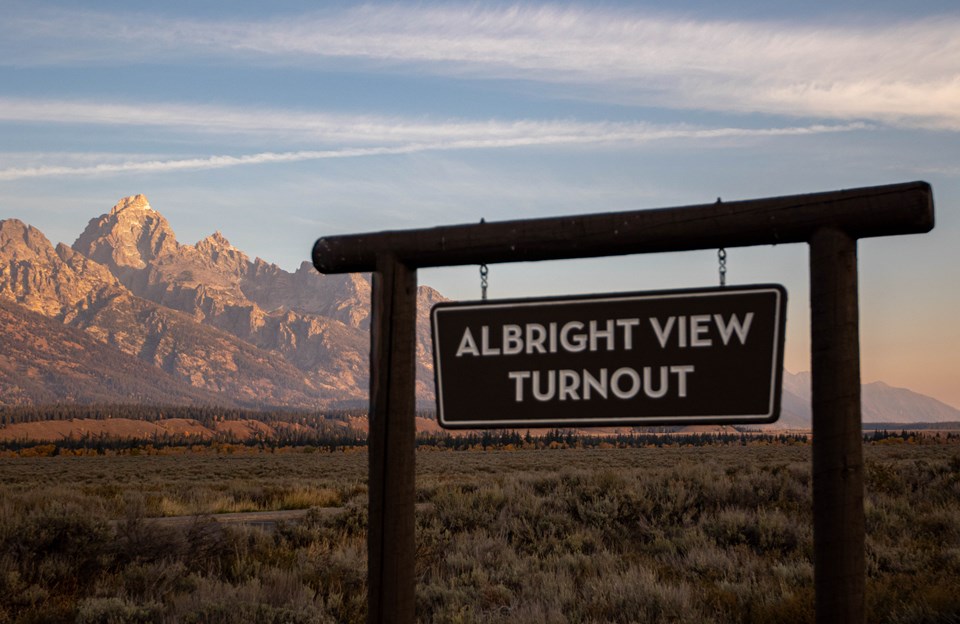
Located in Teton County, Wyoming, Albright View Turnout is a scenic viewpoint. It lies in or next to Grand Teton National Park, so park hours, fees and rules apply. The nearest town is Moose Wilson Road, about 15.8 km (9.8 mi) away (Albright View Turnout lies NE of town).
From the National Park Service
Albright turnout is one of many scenic viewpoints along the highway through the park. Use turnouts like this one to take photos and enjoy wildlife safely. Do not stop along the road on the main highway to keep you and other visitors safe. Although the Teton Range dominates the landscape, make sure to take in the views from all angles. Blacktail Butte and the Gros Ventre Mountains also tower over the valley.
This turnout and a prominent peak in the Teton Range (visible from this location) are named after Horace M. Albright. Albright would eventually become the second director of the National Park Service. However, his connection to Grand Teton National Park happened when he was the superintendent of Yellowstone. It was in 1923 when Horace and many other prominent figures in the valley gathered in Moose, WY to discuss the future of Jackson Hole. Horace sought to protect this area as a national park and sought out the help of John D. Rockefeller which set in motion a plan that would eventually lead to the creation of our park. Biography of Horace Albright Horace Albright was born in 1890 in California. In 1913, Albright graduated from the University of California, Berkeley and moved to Washington DC to begin working as a clerk for the Secretary of the Interior. Although he worked on park issues right away, his focus became nearly exclusively their issues in 1915. That year he became the assistant of newly hired Stephen Mather. In fact, Mather would not join the department unless Albright agreed to be his assistant in order to “’keep me [Mather] out of jail.’” Together they worked to create a parks bureau that resulted in the creation of the National Park Service (NPS) on August 25, 1916. In 1917 Stephen Mather became seriously ill from what was likely bipolar depression. This made it so Mather was unable to do the duties as director of the newly formed NPS. During a span between 1917 and 1919, Albright served as acting director. After Mather could return, Albright took up the jobs of superintendent of Yellowstone and NPS field director. As superintendent, Albright wanted to make Yellowstone a flagship of the agency and demonstrate how a park would be managed under the new National Park Service. Many of the current agency and park-wide policies and functions have roots with Albright. Two of the functions he helped found were visitor services and park mu
Text: National Park Service (public domain) — nps.gov.
Sunrise & sunset directions
At Albright View Turnout the sunrise point swings a long way through the year: about 56° (NE) at the June solstice and 123° (ESE) in late December. Sunset moves from 304° (NW) in June to 238° (WSW) in December, and the midday sun climbs to 70° in summer but only 23° in winter.
| Date | Sunrise | Azimuth | Sunset | Azimuth | Noon sun | Daylight |
|---|---|---|---|---|---|---|
| March equinox (Mar 20) | 7:27 AM | 90° E | 7:35 PM | 271° W | 46° | 12h 08m |
| June solstice (Jun 21) | 5:42 AM | 56° NE | 9:09 PM | 304° NW | 70° | 15h 26m |
| September equinox (Sep 22) | 7:11 AM | 89° E | 7:22 PM | 271° W | 47° | 12h 11m |
| December solstice (Dec 21) | 7:54 AM | 123° ESE | 4:50 PM | 238° WSW | 23° | 8h 56m |
Azimuth is measured clockwise from true north (90° = east, 270° = west). Computed for 2026; values change by less than a degree from year to year.
Golden hour & blue hour by month
Overlooks are about the sweep of the land, so low-angle light matters most: side-light at sunrise or sunset reveals ridges and texture that midday sun flattens.
| Month (15th) | Blue hour starts | Sunrise | Golden hour ends | Golden hour starts | Sunset | Blue hour ends | Daylight |
|---|---|---|---|---|---|---|---|
| January | 7:22 AM | 7:54 AM | 8:39 AM | 4:27 PM | 5:12 PM | 5:44 PM | 9h 18m |
| February | 6:53 AM | 7:22 AM | 8:03 AM | 5:13 PM | 5:53 PM | 6:23 PM | 10h 31m |
| March | 7:07 AM | 7:36 AM | 8:14 AM | 6:51 PM | 7:29 PM | 7:58 PM | 11h 53m |
| April | 6:11 AM | 6:41 AM | 7:19 AM | 7:28 PM | 8:06 PM | 8:36 PM | 13h 25m |
| May | 5:26 AM | 5:59 AM | 6:40 AM | 8:00 PM | 8:41 PM | 9:15 PM | 14h 43m |
| June | 5:06 AM | 5:42 AM | 6:25 AM | 8:23 PM | 9:07 PM | 9:43 PM | 15h 25m |
| July | 5:21 AM | 5:56 AM | 6:39 AM | 8:20 PM | 9:03 PM | 9:38 PM | 15h 07m |
| August | 5:57 AM | 6:28 AM | 7:08 AM | 7:49 PM | 8:28 PM | 8:59 PM | 14h 00m |
| September | 6:34 AM | 7:03 AM | 7:41 AM | 6:57 PM | 7:35 PM | 8:04 PM | 12h 32m |
| October | 7:09 AM | 7:38 AM | 8:17 AM | 6:02 PM | 6:41 PM | 7:10 PM | 11h 03m |
| November | 6:47 AM | 7:18 AM | 8:01 AM | 4:16 PM | 4:59 PM | 5:30 PM | 9h 41m |
| December | 7:18 AM | 7:50 AM | 8:37 AM | 4:01 PM | 4:48 PM | 5:20 PM | 8h 57m |
Local time (America/Denver), including daylight saving time. Golden hour runs from about −4° to +6° solar altitude, so the morning golden hour begins during blue hour, before sunrise.
Milky Way & night sky
From Albright View Turnout, the Milky Way core is visible in a dark sky from March through September. June gives the longest window (about 3.7 hours on a moonless night), and the core peaks around 17° above the southern horizon. Our light-pollution model puts the sky at about Bortle 2 (typical truly dark site), which is excellent for astrophotography.
| Month | Core visible (15th) | Hours | Max altitude | Direction |
|---|---|---|---|---|
| January | Below 10° in darkness | — | -4° | — |
| February | Below 10° in darkness | — | 8° | — |
| March | 5:15 AM – 5:55 AM | 0.7 | 14° | SSE → SSE |
| April | 3:11 AM – 4:51 AM | 1.7 | 17° | SSE → S |
| May | 1:15 AM – 3:45 AM | 2.5 | 17° | SSE → S |
| June | 11:30 PM – 3:10 AM | 3.7 | 17° | SSE → SSW |
| July | 11:17 PM – 1:57 AM | 2.7 | 17° | S → SSW |
| August | 10:20 PM – 11:50 PM | 1.5 | 16° | S → SSW |
| September | 9:13 PM – 9:53 PM | 0.7 | 14° | SSW → SSW |
| October | Below 10° in darkness | — | 8° | — |
| November | Below 10° in darkness | — | -2° | — |
| December | Below 10° in darkness | — | -20° | — |
Window when the galactic core is at least 10° high during astronomical darkness on the 15th of each month. Pick nights within a few days of the new moon. Plan exact nights with the Milky Way planner.
Estimated sky darkness: 2 Bortle 2 — Typical truly dark site. The summer Milky Way shows rich structure; clouds look like black holes in the stars. Modeled zenith brightness ≈ 21.85 mag/arcsec². Aurora needs roughly Kp 6.0+ to show low on the northern horizon here.
Weather & best season
Long-term NASA satellite data for this area show July as the clearest month (about 38% average cloud cover) and December as the cloudiest (71%). July is the warmest month and January the coldest, which matters for gear, snow access and how long batteries last at night.
Average cloud cover (%)
| Jan | Feb | Mar | Apr | May | Jun | Jul | Aug | Sep | Oct | Nov | Dec | |
|---|---|---|---|---|---|---|---|---|---|---|---|---|
| High °F | 33 | 33 | 52 | 69 | 78 | 85 | 92 | 89 | 83 | 74 | 57 | 37 |
| Low °F | -32 | -31 | -23 | -10 | 5 | 22 | 28 | 29 | 18 | -3 | -19 | -27 |
| Precip. (in) | 2.6 | 2.6 | 2.3 | 2.5 | 2.4 | 2.0 | 1.0 | 1.2 | 1.8 | 2.0 | 2.4 | 2.9 |
Monthly climatology for the surrounding 1° grid cell from NASA POWER (MERRA-2). Mountain sites can be colder and cloudier than the cell average.
Photography tips for this scenic viewpoint
- Arrive 30–45 minutes before sunrise or sunset to find a composition before the light peaks.
- Use a telephoto (70–200 mm) to isolate layered ridges and light rays instead of shooting only wide.
- Check the sun azimuth for your date: front-light, side-light and back-light give three different pictures from the same rail.
- Haze builds in summer afternoons; mornings after a cold front are often the clearest.
- Stay behind barriers — many overlook edges are undercut or crumbly.
- Tell someone where you're going in remote areas and carry the ten essentials.
Season: Clear, dry air in autumn and after winter storms gives the longest views; summer adds wildflowers but also haze.
Suggested gear: Tripod, Telephoto lens, Graduated ND filter, Headlamp. Work out exposures with the depth of field, ND filter and NPF rule calculators.
Permits, drones & access
National Park Service rules. Under federal law (54 U.S.C. 100905), still photography in National Park Service areas needs a permit only when it (1) takes place where members of the public are not allowed, (2) uses models, sets or props that are not part of the location's natural or cultural resources or administrative facilities, or (3) would cause the park to incur additional administrative costs to monitor the activity. Ordinary visitor and most landscape photography needs no permit. Commercial filming rules are separate and have changed in recent years — confirm current requirements with the park before a paid shoot.
Drones: Launching, landing or operating unmanned aircraft (drones) is prohibited in National Park Service units under a 2014 Superintendent's closure (36 CFR 1.5), except where a park has issued specific written approval. Flying from outside the boundary over park land can also violate park rules and disturb wildlife.
Nearby photo spots
Other locations within 25 km of Albright View Turnout, closest first.
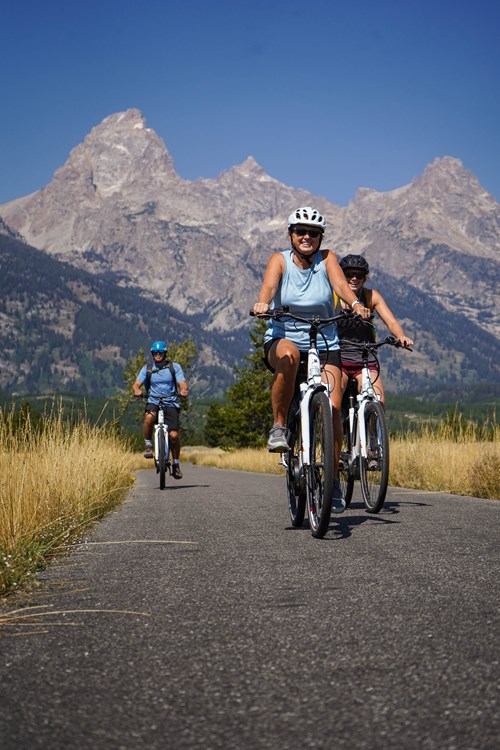 Rock Formation
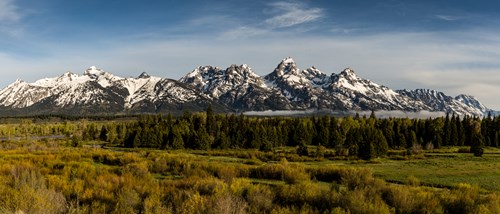 Scenic Viewpoint
 Lake
 Canyon
 Scenic Viewpoint
 Canyon
 Canyon
 Lake
 Canyon
Campgrounds nearby (Recreation.gov)
- Gros Ventre Campground4.1 km (2.5 mi) · reservable
- Jenny Lake Campground13.3 km (8.3 mi) · reservable
- Teton Canyon21 km (13 mi) · reservable
- Reunion Flat23 km (14 mi) · reservable
- Signal Mountain Campground24 km (15 mi) · reservable
FAQ
When is the best time to photograph Albright View Turnout?
What time is golden hour at Albright View Turnout?
Where does the sun rise and set at Albright View Turnout?
Can you see the Milky Way from Albright View Turnout?
Do you need a permit to photograph at Albright View Turnout?
How far is Albright View Turnout from Moose Wilson Road?
Sources
Location data: National Park Service. Sun, moon and Milky Way times are computed by LWPhoto Atlas for 2026. Climate: NASA POWER. Sky darkness is a population-based estimate (Walker's law), not a measurement. See data sources & licenses.